What Is AI Food Photography and How Does It Work
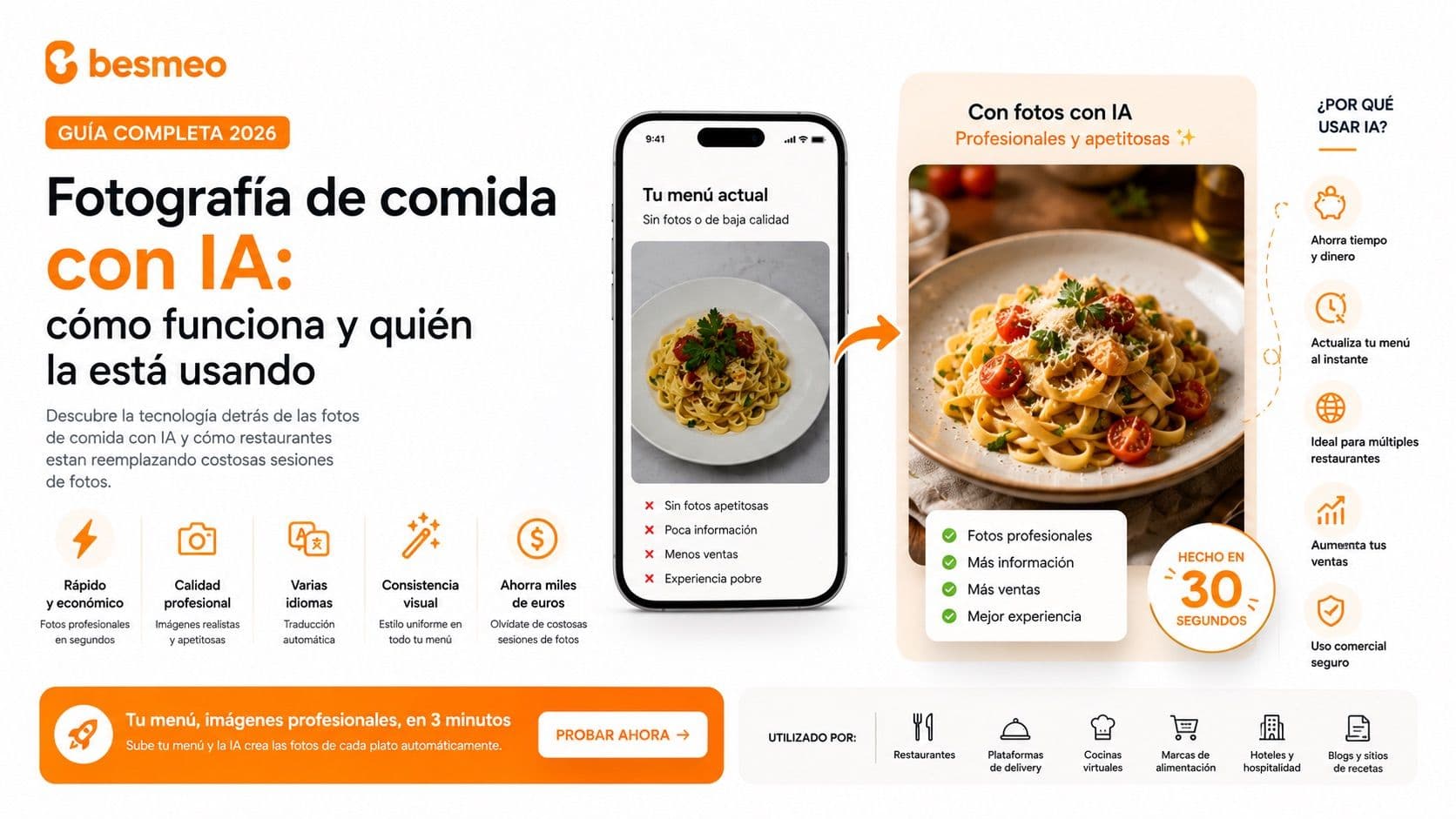
Meta description: How AI food photography works, the technology behind it, and how restaurants are using it to replace expensive photo shoots. Practical guide for 2026.
AI Food Photography: How It Works and Who's Actually Using It
A few years ago, getting professional photos of every dish on your menu meant booking a food photographer for half a day, paying $300-$800, and waiting two weeks for the edited final images. Photos of seasonal dishes? Another shoot. New menu addition? Another invoice.
Today, you can describe a dish in a sentence and have a professional-looking photo of it in 30 seconds. The technology powering this is AI food photography, and it's quietly reshaping how restaurants, food brands, and delivery platforms handle visual content.
This article explains how the technology actually works, where it shines, where it still falls short, and which industries are getting the most value from it right now.
What is AI food photography?
AI food photography is the use of generative artificial intelligence to create realistic images of food dishes from text descriptions or rough source images. Instead of arranging the dish, setting up lighting, and photographing it with a camera, you describe what the dish is — "grilled salmon with roasted vegetables on a white ceramic plate" — and the AI generates the image.
The output is a photorealistic image that, in many cases, is indistinguishable from a professional food photograph to the average viewer. The lighting looks right. The food looks appetizing. The styling matches what you'd see in a high-end restaurant or food magazine.
It's not perfect — we'll get to the limitations — but it's good enough that some of the largest food brands in the world are already using it, and small restaurants are starting to discover it as a way to compete visually without a marketing budget.
How the technology actually works
The simplest explanation: AI image generation models like DALL-E, Midjourney, Stable Diffusion, and newer specialized models like Google's Imagen and Gemini have been trained on hundreds of millions of images paired with text descriptions. They've learned the visual patterns of food — what a properly plated steak looks like, how light reflects off olive oil, what garnishes accompany different cuisines, how to compose a shot of a burger so it looks appealing.
When you give the AI a text prompt like "fresh sushi platter on a wooden board with soy sauce," it doesn't search a database of photos and pick one. It generates a new image from scratch, pixel by pixel, based on what it has learned about how sushi platters look.
For food specifically, AI models have become remarkably good at handling certain details that used to be giveaways — the texture of melted cheese, the steam coming off a hot dish, the way a sauce pools next to a protein. The level of realism has jumped significantly in the past 18 months.
Three things determine the quality of the output:
The model. Newer models trained on more food-specific data perform dramatically better than general-purpose image generators. A general AI model might struggle with sushi. A model fine-tuned on restaurant menus handles it easily.
The prompt. The more specific the description, the better the result. "Pasta dish" produces generic output. "Handmade pappardelle with wild boar ragu, topped with shaved parmesan and parsley, served on a rustic ceramic plate" produces a specific, mouthwatering image.
The post-processing. The best AI food photography tools don't just generate the raw image — they apply consistent styling, color grading, and composition rules so all images look like they belong together. This is what separates professional-looking results from obvious AI output.
What AI food photography does well
For most use cases, AI food photography produces images that are objectively better than what most restaurants currently have. Specifically:
Consistency. Every dish photographed the same way, with the same lighting, the same plating style, the same color palette. A real photographer would charge extra for this level of consistency across a 40-dish menu.
Standard dishes. Burgers, pizzas, pasta, salads, steaks, sandwiches, fish, chicken, desserts. Anything that's been photographed thousands of times before. The AI has so many training examples that the output is reliably good.
International cuisine. Tacos, sushi, pho, curry, paella, dim sum. As long as the dish is well-known enough to appear in cookbooks and food blogs, the AI handles it confidently.
Composition and styling. Plating, garnishing, backgrounds, props. AI has learned the visual grammar of professional food photography — the rule of thirds, complementary colors, shallow depth of field — and applies it automatically.
Speed and cost. What costs $300-$800 and two weeks with a photographer takes 30 seconds and a few cents with AI. This isn't a small difference — it's an order of magnitude.
Where AI food photography still struggles
Be honest about the limitations. AI food photography is not a magic wand. It struggles with:
Unique or regional dishes. Highly specific local dishes that aren't well-represented in training data can come out wrong. A "tortilla española" from AI might look more like a pancake than the actual Spanish potato omelette. The more niche the cuisine, the more carefully you need to review the output.
Custom presentations. If your signature dish has a unique, restaurant-specific presentation — say, a dessert served in a hollowed coconut — the AI doesn't know about your specific style. It'll generate a generic version of the dish, not your version.
Exact ingredient accuracy. If you ask for "salmon with asparagus and quinoa," sometimes the AI will give you salmon with asparagus and rice, or salmon with green beans. For menu items where customers expect exactly what's pictured, you need to review every image.
Branded ingredients or specific brands. AI won't reliably generate a Heinz ketchup bottle or a Coca-Cola can if you ask for one. For dishes that explicitly feature branded items, you'll need real photography or stock images.
Brand consistency for a specific restaurant. If your restaurant has a distinctive visual identity — a specific plate color, a specific tablecloth pattern, a specific lighting style — generic AI won't match it without significant prompt engineering.
The practical workflow most restaurants use: AI photos for 80-90% of standard menu items, real photography for the 10-20% of signature dishes that need accuracy.
The industries getting the most value
While AI food photography applies broadly to anything food-related, certain industries are benefiting more than others:
Independent restaurants and small chains. This is where the impact is largest. A 50-dish menu would cost $1,500-$4,000 to photograph professionally. Most independent restaurants simply can't justify that expense. AI photography brings them to visual parity with much larger competitors at a fraction of the cost. For tourist-area restaurants where customers don't recognize dish names, photos can directly increase average ticket size.
Food delivery platforms. When a new restaurant joins UberEats or DoorDash, they need photos for every dish. Platforms increasingly help restaurants generate these automatically rather than waiting for a photographer.
Cloud kitchens and ghost restaurants. These delivery-only operations live or die by their photos on third-party apps. AI lets them launch multiple virtual brands without separate photo shoots for each.
Recipe sites and food blogs. Need a photo to accompany an article about Thai green curry? AI can produce one in seconds without licensing fees or attribution requirements. Bloggers who used to spend hours sourcing royalty-free images now generate exactly what they need.
Food brands and product packaging. Smaller brands use AI for serving suggestions, recipe inspiration imagery, and social media content. The cost savings on visual content alone can be significant.
Hotel and hospitality groups. Properties with multiple restaurants need consistent visual branding across all of them. AI lets them apply a unified style across hundreds of dishes effortlessly.
How restaurants are actually implementing it
The patterns of adoption fall into three categories:
Standalone AI photo tools. Restaurants generate photos using tools like Midjourney or DALL-E and then upload them manually to their menu platform. This works but adds friction — you need to know how to write good prompts, you need to manually save and organize the images, and you need to do this for every dish individually. Best for restaurants with technical comfort.
AI tools embedded in operational platforms. This is where the technology is moving. Modern digital menu platforms now integrate AI photo generation directly into the menu creation flow. You upload your menu, the system extracts each dish, and AI photos are generated automatically as part of the process. No prompt writing, no manual uploads, no separate tools.
Besmeo is a good example of this approach. The restaurant uploads their existing menu (in any format), and the platform automatically extracts every dish, generates a professional AI photo for each one, translates to 5 languages, and produces a finished mobile menu with a QR code. The AI photography is just one step in an end-to-end automated workflow — the restaurant owner never has to interact with the AI directly.
Hybrid approach. Many restaurants use AI photography for 80% of their menu (standard dishes, sides, drinks, desserts) and real photography for their signature items. This gets them visual consistency for most of the menu while preserving authenticity where it matters.
Quality benchmarks: what good AI food photography looks like
If you're evaluating AI food photography output, here's what to look for:
The lighting looks natural. Soft, diffused light from one direction. No harsh shadows. No flat, evenly-lit "studio" look unless that's the intended style.
The composition feels intentional. The dish is centered or follows a clear compositional rule. There's appropriate negative space around the food. The angle (typically 45° or top-down) matches the dish — pizza is best top-down, burgers are best at 45°.
The textures are right. Crispy things look crispy. Soft things look soft. Sauces have appropriate viscosity. Steam looks like steam, not smoke or fog.
Colors are accurate. Cooked meats look cooked, not raw or burnt. Greens are vibrant but not neon. Sauces match what they should look like (a marinara should look like marinara, not a generic red sauce).
The garnishes make sense. Sushi gets pickled ginger and wasabi. Italian dishes get parsley or basil. Mexican dishes get cilantro and lime. The AI should know which garnishes pair with which cuisines.
No obvious artifacts. AI sometimes generates extra fingers, malformed glassware, or impossible physics. Look closely at the edges of the image and any humans (if present). A good image has none of these tells.
If the output passes these checks, you're looking at AI food photography that customers won't be able to distinguish from professional photos.
Should you use it?
For most independent restaurants, the answer is yes — at least for the bulk of your menu. The economics make traditional photography prohibitive for a 40-dish menu, and most restaurants currently have either no photos or low-quality photos. Moving from no photos to good AI-generated photos is a clear win.
The restaurants where AI photography may not be the right fit: high-end fine dining where customers explicitly value authentic photography of the specific food they'll receive, and restaurants with highly distinctive plating that requires capturing the specific creative work of the chef.
For everyone in between — neighborhood restaurants, tourist-area restaurants, family restaurants, cafes, bars, fast casual concepts — AI food photography is the realistic path to a professional-looking visual menu without the costs and timeline of traditional photography.
See it in action
The fastest way to see what AI food photography actually looks like for your specific menu is to try it on your own dishes. Upload your menu and you'll see AI-generated photos for every dish in about 3 minutes — including the dishes specific to your cuisine.
CTA: See AI food photography on your own menu →