Do AI photos make your menu look fake? The truth without the marketing
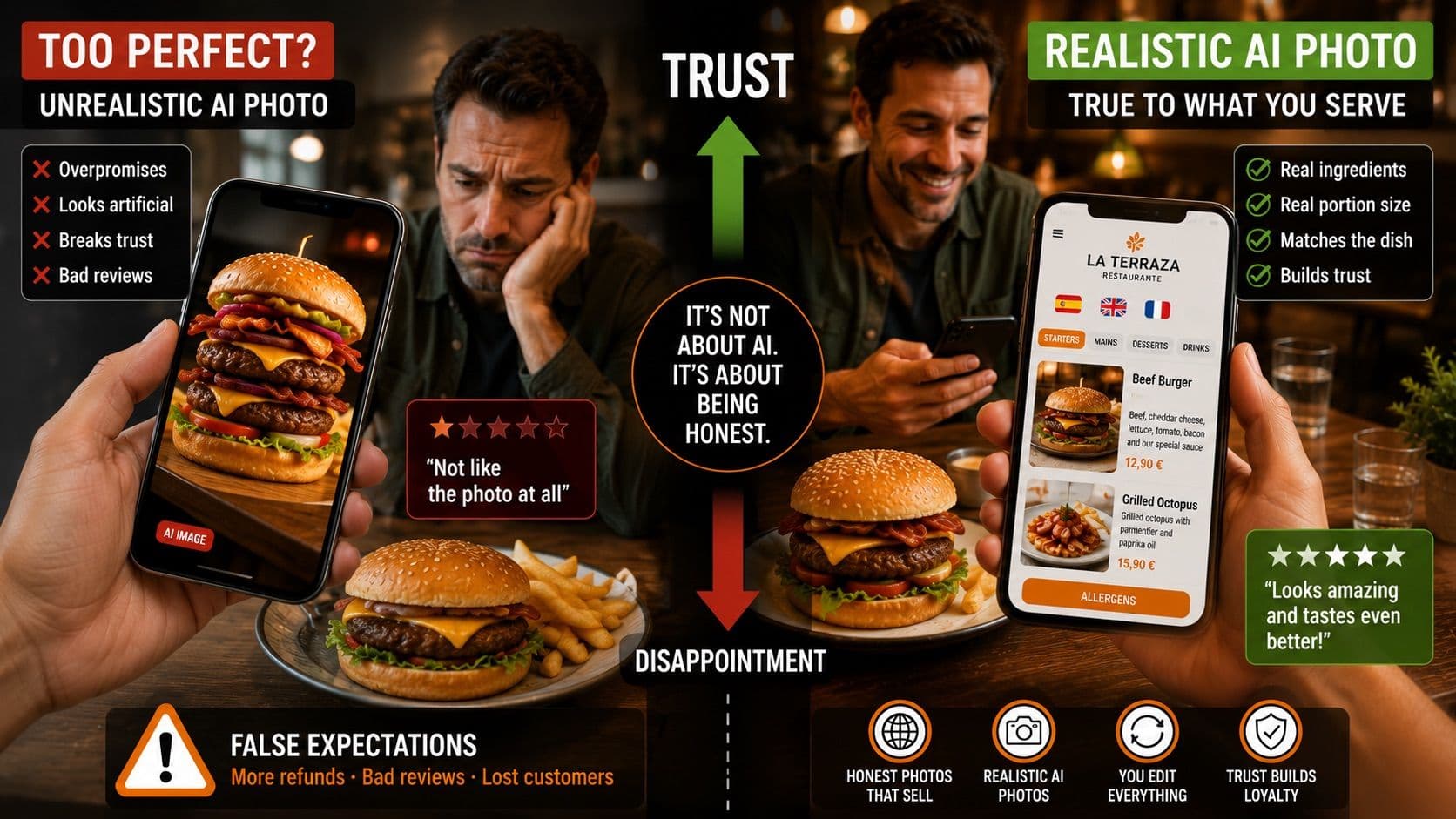
Do AI photos make your menu look fake? The truth without the marketing
If you are hesitant about using AI-generated photos on your menu - because you fear your restaurant might look fake, or that a customer might feel deceived when the actual dish arrives - let me tell you one thing that almost no one trying to sell this to you will say: you are right to be concerned. It is a real risk.
But "real" does not mean "always." It means there is a way to do it that blows up in your face and another way that helps you. And the difference between the two is not what you think. This article is not a brochure to sell you AI photos; it is the honest version of the matter, including the cases that went wrong, so you can decide with your head and not the marketing hype.
The fear is legitimate, and I won't talk you out of it
Let's start with the uncomfortable part, because ignoring it would be treating you like a fool.
In late 2025, a catering platform in the United States replaced, without permission, the real photos of partner restaurants with AI-generated images "to improve quality and visual consistency." The result was a scandal. The restaurateurs themselves described their dishes as "fake food," and customers, far from ordering more, felt they were being duped. The company had to apologize and backtrack.
This is not an isolated case. The complaint "it looks nothing like the photo" is one of the most repeated in food delivery app reviews, and those reviews aren't deleted: they stay there, tanking your rating long after you change the image. Delivery platforms in other countries have even begun to adopt an anti-AI stance, actively removing images they detect as generated from menus.
And here is the real damage, the one you don't see on the first invoice: when a customer suspects you've faked the photo, it doesn't stop there. Their mind makes a leap: "if they lie about the photo, what else are they hiding? The ingredients? The traceability? The kitchen's hygiene?". A photo that looks fake doesn't just disappoint with that dish: it contaminates trust in your entire restaurant. That is why this fear is not a design quirk. It is a brand issue.
Why this happens: the "uncanny valley" and overpromising
There are two mechanisms behind why an AI photo can sink you, and it is worth understanding them to avoid them.
The first is aesthetic: the "uncanny valley." It is that visceral rejection we feel when something mimics reality almost perfectly but fails in one detail. A fork fused to the plate, a texture that looks like plastic, a shadow that doesn't add up, a slightly surreal background. The human brain detects those little lies in milliseconds, even if it can't name them, and reacts with distrust. A single "weird" image on your menu can drag down the perception of all the others.
The second is psychological and, above all, financial: overpromising. Interestingly, it is proven that when people don't know a photo is artificial, they tend to find AI-generated food more appetizing than the real thing. AI optimizes what our brain likes: perfect symmetry, intense colors, impeccable lighting, and, almost always, portions a little larger and more abundant than normal. Sounds good, right? Well, that is the trap.
Because that perfect image calibrates the customer's expectation. They order, convinced that they are going to receive that colossal, symmetrical, and overflowing burger. And fifteen minutes later, the real dish arrives: the bun slightly off-center, the sauce without that millimeter precision, the normal portion. Even if it tastes delicious, the clash between what you promised and what you serve generates a feeling of deception. You turned a customer who was going to leave happy into one who feels scammed. And on delivery platforms, that customer requests a refund and leaves you a bad review.
The conclusion is not "photos sell less." They sell more. The problem is that a photo that promises what you cannot serve is incredibly expensive for you.
The nuance that changes everything: fantasy AI photo vs. realistic AI photo
Here is the idea that separates disaster from success, and almost no one talks about it because it doesn't fit into anyone's marketing:
The problem is not "AI or real." The problem is "faithful or fantasy."
A photo - it doesn't matter if it's AI or from a mobile phone - that shows the dish just as it comes out of your kitchen (the ingredients it actually contains, a realistic portion, a plating similar to the real one) helps. It whets the customer's appetite and, at the same time, correctly calibrates the expectation. When the dish arrives and it looks like the photo, you reinforce trust instead of breaking it.
A photo of an impossible tower, glazed, stylized as if for a magazine, with an abundance that your kitchen could never plate, is the problem. But look: that is not "AI is bad." That is lying with an image. And restaurants have been lying with images since long before AI existed, using stock photos of a burger that wasn't theirs. The tool changes; the sin is the same: promising something you are not going to serve.
So the right question is not "do I use AI photos, yes or no?". It is "does this photo look like what I am going to serve, yes or no?".
How to use AI photos without it blowing up in your face
If you decide to use them, these are the rules that separate a menu that sells from one that generates refunds and bad reviews:
- Ensure it shows the actual ingredients of the dish, not a prettier version. If your salad doesn't have shrimp, don't put them in the photo.
- Realistic portion. No mountains. The volume of the photo should look like the plate that comes out of the kitchen.
- Plating similar to yours. If you serve it in a bowl, don't let it appear in three-star Michelin fine china.
- Review every image before publishing it. A single "weird" photo (uncanny valley effect) contaminates the entire menu. If one doesn't convince you, get rid of it.
- For your star or highly identifiable dishes, use a real photo. These are the ones the customer knows and compares in detail. Don't take a risk there.
- Maintain control. You must be able to swap any generated photo for a real one whenever you want. If a tool doesn't let you, be wary.
The golden rule behind all of them: if in doubt, go for the faithful one. A modest and honest photo sells more in the long run than a spectacular and lying one.
Where to use them and where not to?
Not all channels behave the same way, and it is convenient to distinguish them:
On your own digital menu or QR, at the table: here the realistic AI photo is where it helps the most. The customer is already seated, they will compare the photo with what arrives in a matter of minutes. If the image is faithful, you win: it helps them decide, it opens their appetite, and you deliver on your promise. It is the safest scenario and the one with the highest return.
On delivery platforms (Uber Eats, Glovo, Just Eat, etc.): be very careful. These platforms are moving clearly towards the authentic photo, and even offer their own tools to improve real photos (light, framing, background) instead of generating them from scratch. Some advise against or remove AI-generated images. Here, if you can, use a real photo of your dish or an improvement of that real photo, not one generated from text.
For signature or highly specific dishes: real photo, no discussion. They are your calling card and the ones that are most scrutinized.
In summary: the generated photo shines on your own digital menu and is risky on third-party channels. Treat them differently.
What does this have to do with Besmeo?
I'll tell you clearly, because it would be absurd to hide it: Besmeo generates a photo for every dish on your menu. So, with everything above, the logical question is: "isn't that exactly what you say causes problems?".
The honest answer: it depends on how it is used, and that's why Besmeo is designed for the safe side of the line.
- You maintain total control. You review every photo, adjust the ones that don't convince you, and swap any of them for your own real photo whenever you want. AI saves you the starting work; the final word is always yours.
- The goal is to represent the dish, not to inflate a fantasy. It's not about selling you the impossible tower, but about giving you a menu with images that whet the appetite without promising what your kitchen doesn't serve.
- And for your digital menu at the table—which is exactly the scenario where the realistic photo helps the most and has the least risk—is where it makes the most sense.
In other words: the tool is the co-pilot, you are the one driving. If you want to use real photos for your star dishes and generated ones for the rest, you can. If you want to review them one by one, you should.
You can try it for free with your own menu and see how the images look before deciding anything:
👉 Create your digital menu at
Ready to digitize your restaurant?
Create my menuConclusion
Do AI photos make your menu look fake? They can, if you use them wrong: if they promise a fantasy your kitchen doesn't serve, if they have that "weird" air of the uncanny valley, or if you release them without checking on channels that punish the artificial. That fear of yours is legitimate and it is worth keeping in mind.
But the answer is not "run away from AI photos." It is use them with honesty and maintain control: images faithful to what you serve, reviewed one by one, with a real photo on the dishes that deserve it. Done this way, a good photo doesn't betray you: it sells for you, and on top of that, you deliver what you promise, which is the only thing that truly builds a reputation.
If you want to see how your menu would look with photos - and check for yourself if they are faithful or not before publishing anything - upload your PDF at besmeo.com/create-your-menu and judge it with your own dishes.
Frequently Asked Questions
Is it legal to use AI-generated photos on a restaurant menu? As of today, there is no specific regulation that prohibits them, but general laws on misleading advertising do apply. If a customer can prove that the dish they received is clearly different from the photo, you expose yourself to complaints and claims. The legal key, just like the commercial one, is that the image is faithful to what you serve.
Do customers notice that a photo is AI-generated? More and more. People have become skilled at detecting artificial images, and as soon as they suspect, they assume the worst about your food. A realistic and faithful photo goes unnoticed because it delivers; a fantasy one stands out and reduces your credibility.
Can I use AI photos on Uber Eats or Glovo? With caution. These platforms are clearly favoring the authentic photo and the improvement of real photos over those generated from scratch, and some remove images they detect as AI. For those channels, the safest thing is to use a real photo of your dish.
Is an AI photo better than no photo? A realistic photo, even if it is generated, usually sells more than a dish with just text: the customer orders what they see. The problem is never having a photo; it is having a photo that promises something you are not going to serve.