Allergen Declaration on Restaurant Menus: The Mistake That Could Cost You a €600,000 Fine
Allergen Declaration on Restaurant Menus: The Mistake That Could Cost You a €600,000 Fine
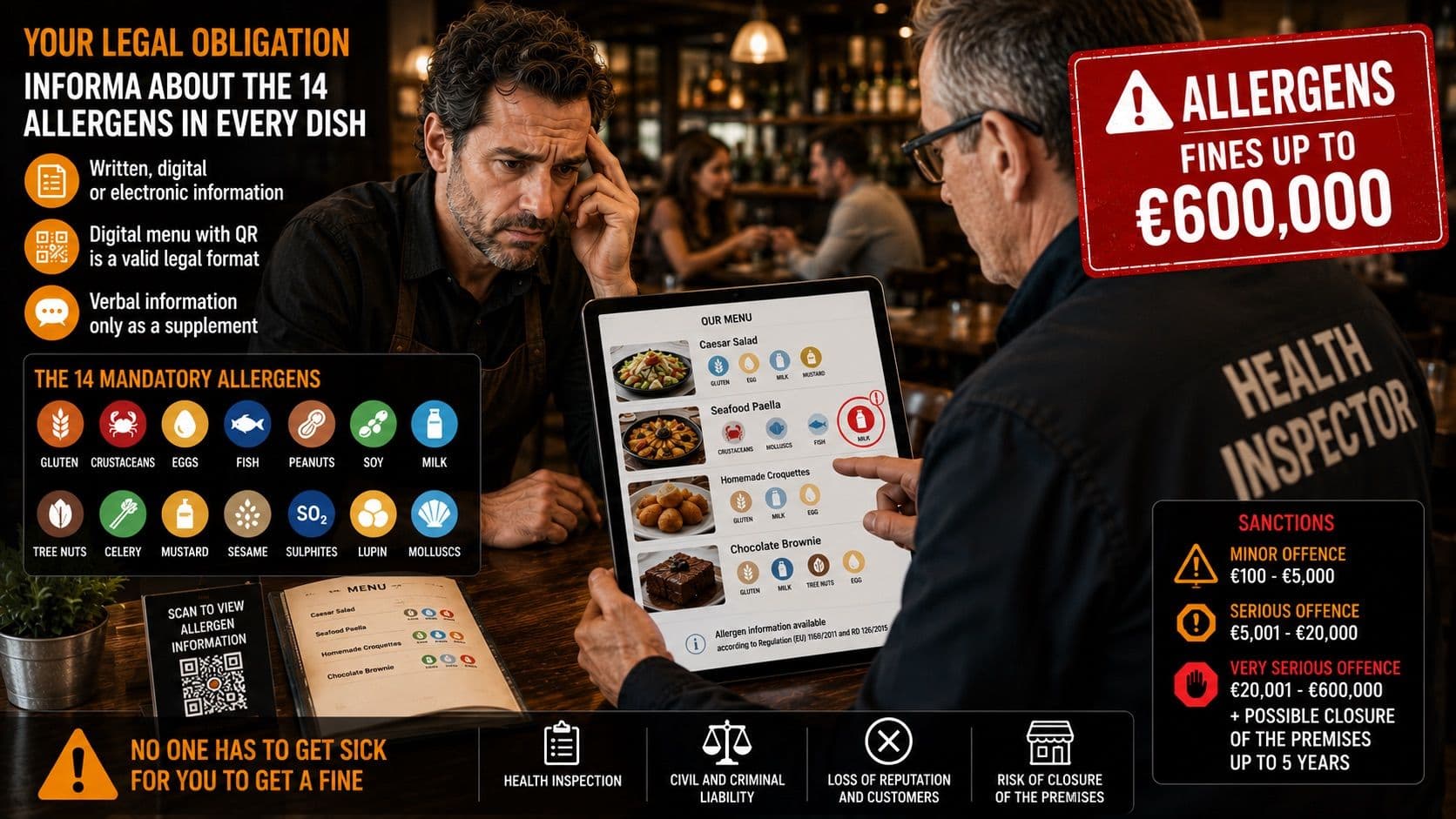
If you run a restaurant, bar, or café in the European Union and serve prepared food, you are legally required to inform your customers about the allergens in every dish. This is not a recommendation. It is not a quality badge. It has been a legal obligation since December 2014, and fines for non-compliance can reach up to €600,000, on top of a possible temporary closure of your business.
The curious thing is that most restaurant owners know they need to "put something" about allergens on display, but very few are clear on what the law actually requires, which mistakes generate the most fines, and — here is the risk almost nobody is talking about — what happens when you translate your menu into other languages and the translation drops or confuses an allergen. That invisible error can cost you far more than a fine.
In this guide, you will find what the law actually says (no legal jargon), which 14 allergens are mandatory, what the real fines look like, and the specific mistakes you need to avoid — especially if you have a digital menu, a QR code, or a translated menu for tourists.
What the law actually says (the version without lawyers)
The regulation comes from two places:
EU Regulation 1169/2011 is the European rule that requires all food service establishments across the EU to inform consumers about the presence of 14 allergenic substances in unpackaged food. It has been in force since December 2014.
In each member state, this regulation is implemented through local legislation. In Spain, for example, Royal Decree 126/2015 specifies how bars, restaurants, and cafés must provide this information. Other EU countries have their own implementing rules, but the 14 allergens and the obligation to declare them are the same everywhere.
In practice, the law says three things:
-
You must declare the 14 mandatory allergens for every dish you serve. A generic sign saying "ask the waiter" is not enough on its own. There must be a document or system where the customer can see which allergens are in each specific dish.
-
The information can be provided in three formats: written on the menu itself, in a separate document accessible in the restaurant (a folder, a board), or in digital or electronic format (QR, screen, digital platform) — as long as the customer can access it at the moment of ordering.
-
Verbal information is allowed, but only as a complement. Your waiter can explain allergens verbally, but there must be a written or digital backup that health inspectors can review. If there is nothing written and no digital record, you are non-compliant.
One detail most people do not know: your digital QR menu is a legally valid format for allergen declaration. If your digital menu includes the allergen information for each dish, you are meeting the legal requirement without needing a separate plastic folder. The only condition is that the customer must be able to access it at the moment of ordering, not behind a login wall or registration.
The 14 mandatory allergens
They are always the same, across the entire European Union:
- Gluten (wheat, rye, barley, oats, spelt, and their hybridised strains)
- Crustaceans (shrimp, prawns, crab, lobster, crayfish…)
- Eggs
- Fish
- Peanuts
- Soya
- Milk (and its derivatives, including lactose)
- Tree nuts (almonds, hazelnuts, walnuts, cashews, pistachios, macadamia nuts, Brazil nuts, pecans)
- Celery
- Mustard
- Sesame seeds
- Sulphur dioxide and sulphites (in concentrations above 10 mg/kg or 10 mg/l expressed as SO₂)
- Lupin
- Molluscs (mussels, clams, squid, octopus…)
Knowing the list is not enough. The important part is correctly assigning the allergens to each dish on your menu, including the hidden ones: soya in a dressing, sulphites in a cooking wine, gluten in a Worcestershire sauce, egg in a homemade mayonnaise. That is where most restaurants fail.
The fines: what it can actually cost you
Penalties are regulated at the national level and can vary by country and region, but the general framework across the EU is this:
Minor infringement (incomplete information, incorrect format, missing sign): fines typically ranging from €100 to €5,000.
Serious infringement (systematic omission of allergens, negligence in providing information that could affect consumers with allergies): fines from €5,001 to €20,000.
Very serious infringement (intentional concealment of ingredients, repeated offences, or situations resulting in direct harm to a consumer's health, such as a severe anaphylactic reaction): fines from €20,001 up to €600,000, plus possible temporary closure of the establishment for up to five years, and direct civil and criminal liability proceedings against the owner.
An important point: the administrative fine can be imposed even if no incident has occurred. A health inspector visits, sees that your allergen information is missing or incorrect, and the fine is issued. Nobody needs to get sick for you to be sanctioned.
The mistakes that generate the most fines (and the one nobody is telling you about)
Most sanctions do not come from bad intentions. They come from not being clear on what counts as compliant and from mistakes that seem minor:
Mistake 1: the generic sign. Putting up a small sign that says "Ask our staff about allergens" does not meet the legal requirement if there is no written or digital document behind it that records which allergens are in each specific dish. This is the most common error and the first thing an inspector looks for.
Mistake 2: the outdated menu. You switch bread suppliers and the new one contains sesame. Your cook substitutes an ingredient due to a stock issue and introduces an allergen that was not there before. If your allergen declaration does not reflect that change, you are providing false information — which is worse than providing none at all.
Mistake 3: verbal-only information. Your waiter knows exactly what is in every dish, but there is nothing written or digital. The day an inspector visits, the waiter's memory does not count. They need to see a document.
Mistake 4: confusing allergens with "may contain traces". Allergen declaration and trace warnings for cross-contamination are two different things. You must declare the allergens that are in the dish. Traces are an addition, not a substitute. And you cannot use a blanket "may contain traces of everything" disclaimer as an excuse not to declare anything.
And now the mistake nobody is telling you about: the translation
This is the one that should worry you most if you have a translated menu in multiple languages — whether on paper, digital, or QR.
Picture this: your Spanish menu correctly declares that your croquettes contain milk and gluten. You translate the menu into English, German, or French. What happens if the translation drops one of the allergens? Or if it mistranslates an ingredient and the tourist with an allergy does not recognise the allergen in their language?
This risk is not theoretical. Automated translations in hospitality have been producing errors for years, ranging from the comical (translating a Spanish wine name literally as "he came from the earth") to the dangerous. A dish containing Worcestershire sauce (which includes fish and gluten) translated into German without flagging those allergens could end up on the table of a coeliac who trusted your translated menu.
And here is the legal reality: liability always falls on the restaurant owner. Not on the translator, not on the tool, not on the platform. If a tourist with a crustacean allergy trusts your translated menu, eats the dish, and suffers a reaction, you are responsible. It does not matter who did the translation.
This does not mean you should avoid translating your menu. On the contrary, a translated menu is a huge advantage for restaurants in tourist areas. It means that allergen information in translated menus needs human review, always. Any automatic translation tool — any of them — can make mistakes with complex ingredients, colloquial sauce names, or sub-ingredients that are hidden allergens. The general text of the menu can go automatic; allergen information cannot.
How to comply without overcomplicating things
With all of the above, what you need is a system that:
- Assigns the 14 allergens to each specific dish, not a generic disclaimer.
- Can be updated instantly when you change an ingredient or a supplier.
- Is accessible to the customer at the moment of ordering (on the menu, in a separate document, or in digital/QR format).
- If you translate your menu, the allergens for each dish must be correctly reflected in all languages, reviewed by you or someone who knows the kitchen.
A digital menu (with QR) has a massive advantage here, and it is the one that gets talked about least: when you change an ingredient, you update the allergens in one place and it is reflected everywhere instantly — no reprinting, no crossing things out with a pen, no forgetting to update the folder. For a business where ingredients change due to stock issues or seasonal shifts, a digital menu turns allergen compliance from a constant headache into something you manage in seconds.
What to do if you have a translated menu for tourists
If your restaurant is in a tourist area and your menu is in several languages (or you are considering it), follow these rules:
- Allergens must appear in every language, not just the original. If your English menu does not declare allergens for each dish, you are not compliant for that customer.
- Personally review the allergens in each translation. The dish description can go automatic; the allergens need you (or someone who knows the recipe) to verify they are correctly reflected in every language.
- Use the standard pictograms for the 14 allergens. They are universal and language-independent. A shrimp icon (crustaceans) or a wheat ear (gluten) is understood in any language. They are your visual safety net.
- Document changes. If you switch a supplier or a recipe and it affects allergens, update it across all versions of the menu at the same time.
Besmeo and allergens: what it does and what you need to do yourself
Let me tell you this with the same honesty as the rest of this article. Besmeo lets you create your digital QR menu, translated into multiple languages, from your existing menu. That gives you the foundation to have allergens in digital format (a legally valid format) and update them instantly.
But — and this is important — assigning allergens to each dish and reviewing them in every language is your responsibility. No automated tool, not Besmeo and not any other, can guarantee that the allergens in your "secret sauce" are correctly declared, because only you (or your chef) knows what actually goes into each dish. The tool gives you the support and the format; the allergen content is yours to verify.
That said, having your menu in digital format gives you a real compliance advantage: when you change an ingredient, you update the allergens in one place and it reflects across all tables and all languages instantly, without reprinting anything. That turns a process that on paper is slow and error-prone into something fast and centralised.
You can try it free with your own menu:
👉 Create your digital menu at Besmeo
Ready to digitize your restaurant?
Create my menuConclusion
Allergen declaration is mandatory in all restaurants, bars, and cafés across the European Union since 2014. Fines range from €100 to €600,000, and no incident needs to occur for you to be sanctioned — a failed inspection is enough.
The most common mistakes are not malicious. They are the generic sign that does not comply, the menu that is not updated when an ingredient changes, and above all, the translation that drops or confuses an allergen in another language. This last one is the most dangerous because it directly affects a tourist who is trusting your menu to eat safely.
A digital QR menu is a legally valid format and makes compliance easier because it updates instantly. But remember: the tool gives you the support; you review the allergens, in every language, every time a recipe changes. That part is not delegable.
If you want to set up your digital menu and have a platform that makes it easier to manage allergens across all languages, try it free at besmeo.com/create-your-menu.
Frequently asked questions
Is allergen declaration mandatory in my restaurant? Yes. Since December 2014, all food service establishments in the EU that serve prepared food must inform customers about the 14 mandatory allergens in every dish. It is not optional.
What are the 14 mandatory allergens? Gluten, crustaceans, eggs, fish, peanuts, soya, milk, tree nuts, celery, mustard, sesame, sulphites, lupin, and molluscs.
Can I declare allergens on a digital QR menu? Yes. EU Regulation 1169/2011 and its national implementations accept digital or electronic formats, as long as the customer can access the information at the moment of ordering. Your QR menu is a legally valid format.
How much is the fine for not declaring allergens? It depends on the severity: from €100 to €5,000 for minor infringements, €5,001 to €20,000 for serious ones, and up to €600,000 for very serious cases, with possible closure of the establishment.
Is it mandatory to declare allergen traces? Trace declaration for cross-contamination is not regulated in the same way as the 14 mandatory allergens, but informing about them is recommended to protect your customers and yourself. A blanket "may contain traces of everything" disclaimer is not a valid substitute for proper allergen declaration.
What happens if my menu translation omits an allergen? Legal liability falls on you as the restaurant owner, not on whoever did the translation. If a customer suffers a reaction because of an undeclared allergen in a translated version of your menu, you are responsible. Always review allergens in every language.