Best Menu Solution for Tourist Restaurants in 2026: The Ultimate Guide
Slug: best-digital-menu-tourist-restaurants Meta-description: Discover the best digital menu solution for tourist restaurants. Automatically translate your menu into 5 languages and boost sales with AI food photography. Short Description: The best digital menu to sell more to global tourists in 2026.
Best Menu Solution for Tourist Restaurants in 2026: The Ultimate Guide
If you manage a restaurant in a city with a high volume of international tourism—such as Miami, New York, Las Vegas, or major European destinations—you are playing in a completely different league than a traditional neighborhood bistro.
Your potential customer is not the local office worker who already knows your dishes by heart. Your potential customer is a traveler who just landed after an eight-hour flight, is dealing with jet lag, is hungry, feels overwhelmed by a new city, and, most likely, does not speak your local language fluently.
In this high-friction scenario, your menu ceases to be a simple list of prices. It becomes the sole communication tool between your kitchen and the customer's wallet. If that tool fails to communicate effectively, you lose money. A lot of money.
In this comprehensive guide, we will break down exactly what makes a digital menu the best menu solution for tourist restaurants in 2026. We will analyze the psychology of the international diner, the critical importance of breaking the language barrier, the universal selling power of photography, and why outdated technological solutions are quietly costing you thousands of dollars every tourist season.
1. The Psychology of the Tourist: The "Safety Net" Sinking Your Margins
To understand what kind of menu you need, you first have to understand how a tourist thinks when they sit down at your table.
Imagine a family of German tourists sitting in a seafood restaurant in Miami, or a Japanese couple in a traditional New York steakhouse. They open your physical menu. They see a list of 40 dishes described in a language they barely comprehend, featuring local ingredients and culinary techniques they don't know how to translate.
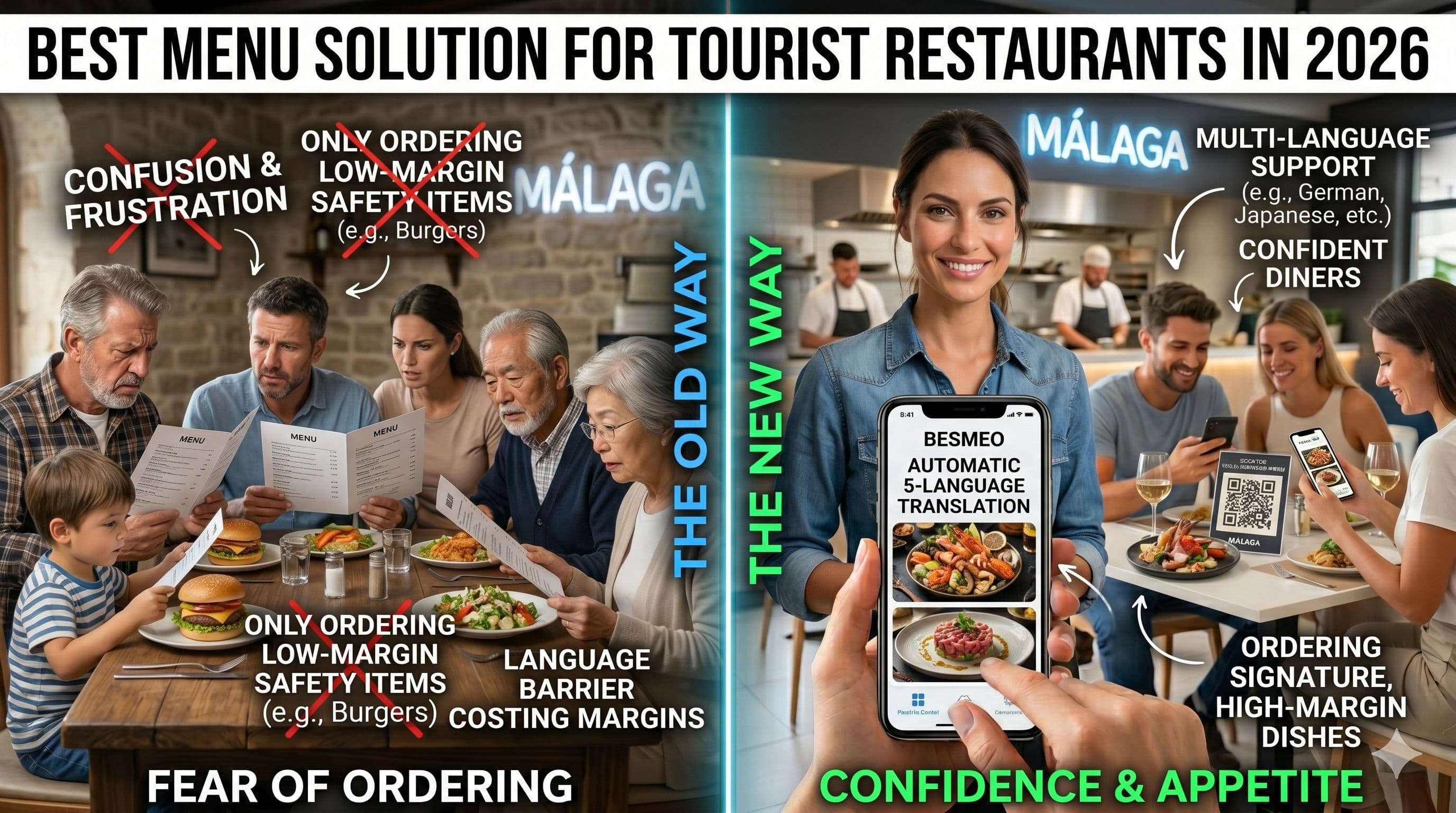
What happens in their brain? They enter what consumer psychology calls "risk-aversion behavior." Because they do not want to risk ordering something they might dislike, something too spicy, or something containing an unfamiliar ingredient, they completely ignore the signature dishes, the local specialties, and the premium cuts of meat. Ironically, these are precisely the dishes that leave you with the highest profit margin.
Instead, they look for their "safety net." They scan the menu looking for universal words they recognize anywhere in the world: Burger, Pizza, Pasta, Chicken Salad.
The result is financially devastating for your bottom line: a customer who was fully prepared to spend $45 on your "Citrus-Glazed Local Mahi Mahi" ends up ordering a $16 cheeseburger simply because it was the only word they confidently understood. Multiply that loss of margin by hundreds of tourists a week, and you are looking at a massive black hole in your annual revenue.
2. The Fallacy of the "English-Only" or Printed Bilingual Menu
For decades, the hospitality industry's standard solution for tourism was to have one menu in the local language and another in English. But in 2026, tourism is truly global. English might be the international language of business, but it is not the language of comfort.
When a customer reads a menu in their native language, they relax. They understand the culinary nuances, the cooking techniques, and, most importantly, the allergens. Trying to solve this with a physical printed menu in five or six languages is practically impossible:
- Visual Clutter: It looks like a dense dictionary rather than an appetizing restaurant menu.
- Exorbitant Costs: It is incredibly expensive to print, and you have to incur that cost every single time you need to update a price or change a seasonal dish.
- Translation Disasters: It requires hiring professional translators. Relying on basic Google Translate for a printed menu usually ends in viral disasters (like translating the traditional Spanish dish "Ropa Vieja" literally into "Old Clothes").
To capture the true purchasing power of the global tourist, you need a solution that speaks their native language, whatever that may be, without cluttering the table with paper.
3. Visual Appeal: The Universal Language of Gastronomy
If there is one thing that transcends any linguistic border, it is visual hunger. Human beings process images thousands of times faster than text.
For a tourist, a photograph is not just "pretty"; it is a functional necessity. It is the guarantee of what they are going to receive on their plate. If a tourist doesn't know what "Slow-Smoked Brisket" means, a high-quality photo showing the juicy meat, the distinct smoke ring, and the glossy glaze will sell the dish instantly.
However, independent restaurants in tourist areas often lack photos on their menus because traditional food photography is prohibitively expensive (ranging from $500 to $1,500 per session). This historically left independent restaurants at a severe disadvantage against large fast-food chains, which flood their menu boards with highly engineered, appetizing images.
The ideal menu solution in 2026 must incorporate high-quality visual elements for every single dish, leveling the playing field and allowing your best food to speak for itself through the tourist's eyes.
4. Ease of Access: The "Zero Friction" Rule
Tourists face technological constraints that locals simply do not have. A customer from your own city has unlimited 5G data and knows the local network. An international tourist often:
- Is using international data roaming, which is frequently slow and expensive.
- Relies on the restaurant's spotty Wi-Fi.
- Has their phone battery at 15% after spending the entire day taking photos and navigating via Google Maps.
For these reasons, you must never force a tourist to download an App to view your menu. The abandonment rate for restaurant app downloads is staggering, hovering near 90%. If there is friction, they will just ask the waiter for a physical menu, completely defeating the purpose of your digital system.
Similarly, the outdated QR code that links to a heavy, 15-megabyte static PDF file is a nightmare for a tourist with a bad connection. Furthermore, it forces them to "pinch-and-zoom" on their screen to read tiny text, frustrating the experience before they even order a drink.
The best menu solution must be a lightweight Web App accessed via an instant QR scan, loading in under a second, and designed specifically to be navigated with a single thumb on a mobile screen.
5. Besmeo: The Ultimate Solution for Tourist Restaurants
When you combine all the aforementioned challenges—the language barrier, the need for visual impact, frictionless access, and agile updating—most market tools fall short. POS systems offer boring text. PDFs cannot be translated. Manual menu builders demand weeks of your time.
This is where Besmeo has positioned itself as the definitive tool for restaurants in tourist epicenters worldwide.
Besmeo was engineered with a simple premise: the most advanced technology in the world is useless if the restaurant owner has to spend hours configuring it.
A. From Boring PDF to UberEats-Style Menu in 2 Minutes
The biggest hurdle to digitizing a restaurant is the manual labor involved in data entry. With Besmeo, you do not have to type out your dishes one by one. You simply upload your current printed menu file. Besmeo's artificial intelligence magically extracts all the text, prices, and descriptions, and converts boring PDFs into interactive, UberEats-style menus in two minutes. You get a clean, modern interface optimized purely for mobile conversion, with zero design skills required.
B. Automatic 5-Language Translation
Say goodbye to "Spanglish" menus or awkward phrasing. The instant you upload your PDF, Besmeo automatically translates your entire menu into 5 of the most spoken languages in global tourism. This is not a robotic, literal translation; it is an AI trained specifically in gastronomic terminology that knows exactly how to describe your dishes so they sound appetizing in French, German, Italian, or Japanese. The customer's phone detects their preferred language and displays the menu in their native tongue instantly.
C. AI Food Photography for Every Dish
This is the feature that multiplies average ticket sizes. Besmeo solves the problem of exorbitant photography costs by utilizing cutting-edge generative AI. The platform reads the description of your dishes and instantly generates photorealistic, studio-quality images for every single item on your menu. Suddenly, that tourist who didn't know what to order is salivating over hyper-realistic photos of your high-margin signature dishes—and you didn't have to hire a photographer or organize a stressful shoot.
D. Frictionless QR Access with Zero Downloads
The Besmeo menu lives in the cloud via dynamic QR codes. The tourist sits down, scans the code, and in fractions of a second, they are browsing a highly visual catalog in their own language. There are no app downloads, no long loading times, and no frustrating pinch-to-zoom PDFs. Everything flows seamlessly, replicating the smooth experience of top-tier delivery apps, but inside your dining room.
Conclusion: The ROI of Speaking the Customer's Language
Operating a restaurant in a tourist-heavy city is a privilege, but it requires specific tools to capitalize on that high-volume traffic. Every time a tourist fails to understand your menu and orders a cheap side dish out of fear of making a mistake, your business is leaking profitability.
In 2026, the excuse that "software is complicated" or "photos are too expensive" is no longer valid. Automation technology has democratized access to top-tier gastronomic marketing.
If you want the tourists visiting your city to stop ordering the basic burger and start ordering your highest-margin dishes with total confidence, you need to provide them with an environment where they feel safe, understood, and visually stimulated.
Do not let an invisible language barrier cost you thousands of dollars this season.
Upload your boring PDF menu now and discover how Besmeo transforms it into an interactive, multi-language menu with AI photos in just 2 minutes →