Digital Menu for Hotels: Room Service, Buffet, and Breakfasts
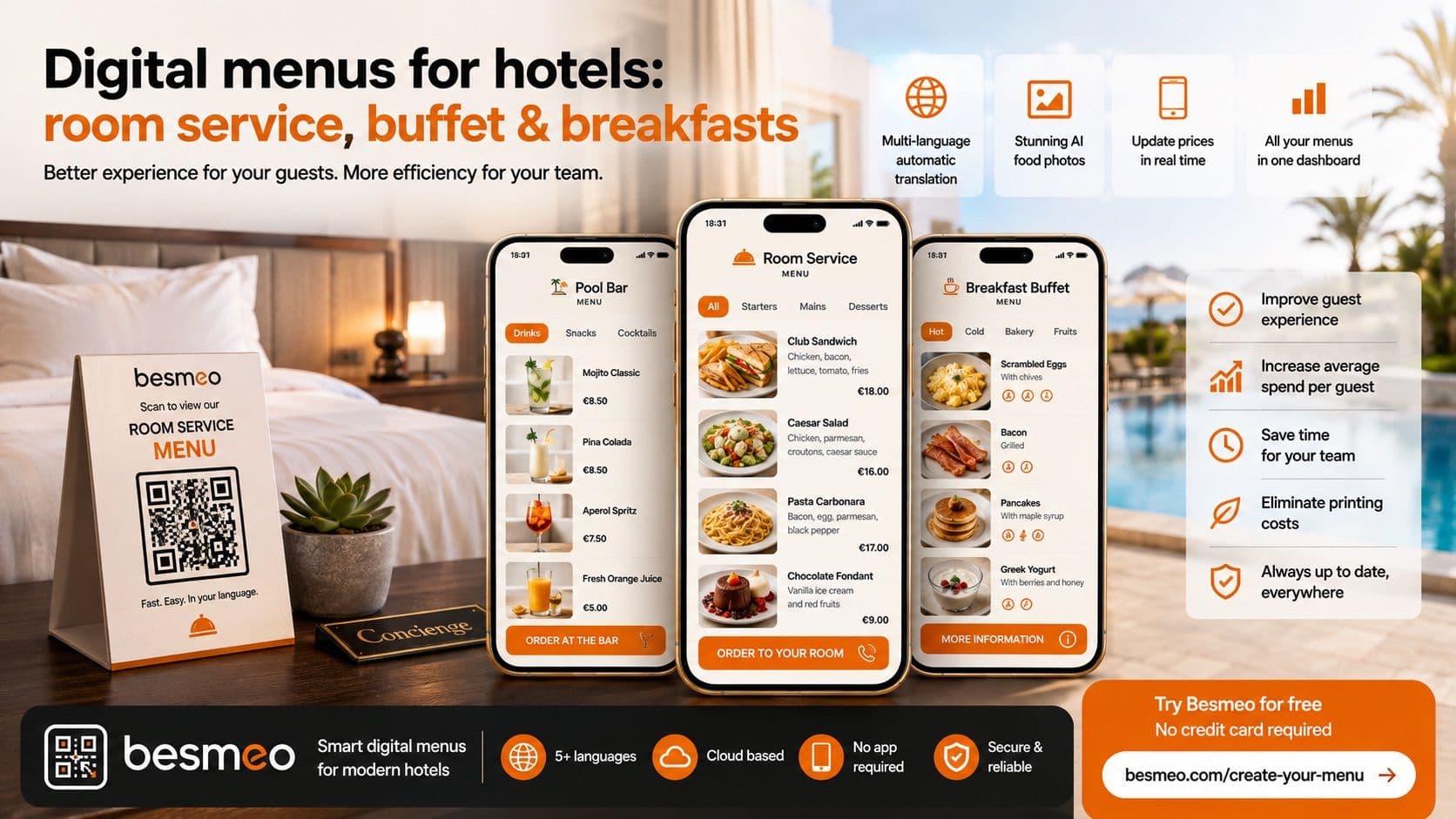
Digital Menu for Hotels: Room Service, Buffet, and Breakfasts
Managing Food & Beverage (F&B) within a hotel is inherently far more complex than running a traditional restaurant. When you manage a hotel's gastronomy, you are not simply overseeing a single dining room with predictable customer flows. You are orchestrating a complete ecosystem that operates from early morning until late at night, spread across multiple sales outlets: the main restaurant, the café, the pool bar, the terrace, event services, and, of course, the privacy of guest rooms via room service.
Furthermore, your target audience is not a local resident who already understands the city's culinary culture. By default, your guest is an international traveler. They are visitors who arrive tired, likely unfamiliar with the local language, holding high expectations because they are paying for a complete accommodation experience, and seeking absolute convenience. In this high-stakes scenario, how you present your culinary offerings is not a minor detail; it is a fundamental pillar that determines the profitability of your F&B operations.
For years, the hotel industry has relied on costly, rigid, and hard-to-maintain printed solutions. Leather folders in rooms with laminated sheets that become outdated a month after printing. Buffet labels that nobody understands. Poolside menus ruined by sun and water. Today, the standard has changed. In this comprehensive 2026 guide, we will analyze in depth why a digital menu for hotels is the ultimate tool to modernize room service, organize the buffet, captivate the international guest, and above all, unify the management of all your sales outlets under a single digital umbrella.
1. Initial Definition: What is a Digital Menu for Hotels, Really?
Before diving into the operational problems it solves, we must establish a clear definition of what a "digital menu for hotels" truly means today.
A real digital menu is not a static PDF hosted on a server that guests access via a QR code. That approach, which was a valid emergency measure during the 2020 health crisis, is now considered a poor user experience. A PDF forces the guest to pinch-and-zoom on their mobile screen, fails to adapt to different device sizes, doesn't allow filtering by allergens, and most critically, cannot be dynamically translated or updated without completely redesigning and re-uploading the entire document.
A true digital menu for hotels is a Progressive Web App (PWA) hosted in the cloud, specifically optimized for mobile viewing (Mobile-First). It is an interactive, visual catalog where dishes are organized by navigable categories. It is a living platform that detects the guest's phone language and displays the content in their native tongue. It includes high-quality photographs of each product, detailing ingredients and allergens clearly. For hotel management, it is a centralized dashboard from which prices can be modified, sold-out items hidden, or chef's specials added in seconds—with changes reflecting instantly across every QR code scanned throughout the entire hotel property.
In a hotel context, this technology acts as a silent, multilingual digital concierge available 24/7 in every guest's pocket, ready to sell the establishment's culinary offerings with zero friction.
2. The Death of the Laminated Folder: The Chronic Problem of Room Service
Room service has traditionally been one of the hardest services to make profitable in hotel hospitality. Despite high product margins, operational and logistical costs often eat up the profits. But the biggest bottleneck for increasing in-room sales has always been the physical menu itself.
Consider the iconic leather or plastic folder resting on the room desk. This folder is a black hole of inefficiency for several reasons:
Constant Obsolescence: Printing room service menus for 200 rooms is a massive expense. Consequently, hotels avoid changing the menu. If an ingredient's price skyrockets, the hotel absorbs the margin loss because reprinting 200 menus is too costly. If a dessert is no longer available, the guest orders it, and reception has to call them back to apologize and ask them to choose something else, creating a disappointing experience.
Lack of Visual Appeal: Physical room menus are usually dense blocks of text. Guests arrive tired at their room, pick up the folder, and read "Club Sandwich - 18€". It's a cold transaction. There is no visual stimulus. In an environment where the customer is alone and tired, impulse buying requires imagery. A digital menu with spectacular photographs turns hunger into an immediate order.
Hygiene and Maintenance: Post-pandemic, sensitivity toward shared objects shifted. Physical menus in rooms get stained, deteriorate, collect dust, and require housekeeping staff to spend time checking and disinfecting them daily.
By replacing the physical folder with a QR code elegantly integrated into the room's design (on the nightstand, mirror, television, or key card), the hotel instantly eliminates printing costs. The QR code in the room replaces the traditional laminated folder. Now, if the chef decides to launch a midnight special or change the price of a bottle of champagne, they can do it from their phone, and the menu in every hotel room updates instantly.
3. The Silent Chaos of Buffets and Breakfasts Without Multilingual Labeling
The breakfast buffet is often the last culinary impression a guest takes with them before checking out. It is also one of the most operationally tense moments for the dining room staff.
One of the most invisible yet damaging problems of the buffet is the lack of clear information. In an international buffet, you have dozens of trays and containers. Physically, it is impossible to place descriptive signs in 5 different languages in front of every tray without making the counter look like a cluttered bulletin board. As a result, hotels choose to put small signs in the local language and English (e.g., "Scrambled eggs").
What happens to guests who don't speak either language or have strict dietary restrictions? They approach the buffet with uncertainty. A tourist with celiac disease or a dairy intolerance won't risk trying a casserole if they aren't 100% sure of its ingredients. This creates two terrible scenarios: the guest limits themselves to fruit and bread (taking away a poor experience from a buffet they paid for), or they constantly stop dining room staff to ask "Does this have milk? Does this have pork?".
A digital menu tailored for the buffet solves this chaos. Through a single generic QR code placed at the entrance of the dining room or on the tables, the guest accesses the complete breakfast offering. Upon scanning it, the system detects that their phone is set to German, for example, and displays the complete list of buffet items in German, detailing exactly what each tray contains and visually filtering out allergens. The workload on staff answering questions is drastically reduced, and the guest gains autonomy, security, and satisfaction.
4. International Guests by Default: Overcoming the Language Barrier
Unlike a neighborhood pizzeria, a hotel thrives on global traffic. Receiving guests from France, Germany, Japan, the United States, and Brazil in the same week is not an operational exception; it is the industry norm.
When an international tourist sits down at your hotel restaurant and is handed a menu in a language they don't understand, a psychological mechanism of self-defense and risk aversion triggers. The customer won't order your signature dish, that "Wild sea bass fillet on fennel bed with saffron emulsion" that leaves an excellent profit margin. They won't order it simply because they are afraid of making a mistake, not liking it, or misunderstanding the local ingredients.
To play it safe, the guest will look for universal terms they can recognize. They will order "Pizza", "Burger", "Pasta", or "Salad". Safe-haven dishes. And that is how, because of a language barrier, you just lost the opportunity to sell a €35 dish and ended up selling a €15 one.
Traditional solutions (printed menus in multiple languages) are costly, aesthetically cluttered, and hard to maintain. Hiring human translators every time you change the menu is a bottomless money pit.
An intelligent digital menu eliminates this barrier instantly. The guest scans, and the menu speaks their language automatically and accurately. Culinary translation gives the international customer the confidence to explore, be adventurous with their culinary choices, and consequently, spend more. Confidence is the engine of tourism consumption.
5. Multiple Sales Outlets: One Restaurant, One Bar, One Pool, and 200 Rooms
The great challenge of hotel Food & Beverage is fragmentation. Managing physical menus for the fine dining restaurant, the cocktail list for the lobby bar, the snack menu for pool sun loungers, and the room service menu is an administrative juggling act.
Every time management decides to change a beer brand or adjust coffee prices, it triggers a chain reaction of audits to ensure updates were made across all brochures in all sales outlets. Invariably, an old menu is always left forgotten on a sun lounger, which a customer can use to claim an outdated price.
The digital ecosystem centralizes this chaos. With a digital menu platform, the F&B Director has a single dashboard. From there, they can manage the "Restaurant Menu", "Pool Menu", and "Room Service". Each sales outlet has its own specific QR code. If avocados run out, they are hidden from the corresponding dishes across all menus with a single click. If Happy Hour starts at 6:00 PM at the pool bar, a new category of discounts activates instantly.
This operational agility is impossible to replicate in the physical world and gives the hotel unprecedented flexibility to maximize profits and run A/B tests on prices or products risk-free.
6. Higher Ticket Size: Why Your Menu Demands a Premium Visual Experience
Hotels have an inherent advantage over independent restaurants: the captive customer and the ability to charge a higher average ticket for the exact same product, justified by convenience, safety, and environment. A club sandwich in a four-star hotel costs significantly more than in the café across the street.
However, to sustain that premium pricing strategy, the perception of value must be impeccable. You cannot charge top-tier prices supported by a plain, boring text menu. You have to make the guest crave the product. And in gastronomy, desire enters through the eyes.
Multiple consumer psychology studies consistently demonstrate that including photos in menus substantially increases sales of those specific items. When guests can see the gloss of the sauce, the freshness of the vegetables, or the perfect sear on the meat, their brains make the purchase decision before even reading the price. Photography eliminates cognitive friction.
The traditional obstacle was the exorbitant cost of professional food photography. Photographing 80 items (across room service, restaurant, and bar) meant spending thousands of euros and paralyzing the kitchen for days. Today, thanks to Artificial Intelligence, this barrier has completely disappeared, allowing any hotel to offer a dazzling visual catalog that fully justifies its pricing policy.
7. Honest Section: The Limits of Digitalization in Hotels
To be fair and rigorous, it is essential to address what a digital menu cannot do. Technology is a lever, not a magic wand. If you are going to implement QR codes in your hotel, you must be aware of their real limitations:
1. Room connectivity dependency: If your hotel Wi-Fi is poor, or if there are rooms at the ends of hallways where 4G/5G mobile data signals don't reach, the digital menu will be a source of frustration. A guest who scans a QR code and stares at a blank loading screen for 30 seconds will end up annoyed. Your hotel's network infrastructure must be solid.
2. Technological anxiety of the senior cohort: While the vast majority of guests (including those over 65) have grown accustomed to QR codes post-2020, there will always be a small percentage of customers with a technology aversion. A hotel of excellence must offer alternatives. The digital menu is the standard for 95% of guests, but reception should always have clean, large-font physical copies available for the 5% who explicitly demand paper.
3. Physical logistics do not disappear: An interactive digital menu with stunning photos will make room service orders increase. Guaranteed. But if your hotel doesn't have enough kitchen staff to handle that volume, or if delivery times to rooms exceed 45 minutes, technology will only generate more complaints. Software digitizes desire and orders, but delivering that club sandwich still relies on your waitstaff's feet.
4. "App fatigue": Never, under any circumstances, force a guest to download an app from their mobile app store just to view a menu. Travelers hate downloading apps they will only use for 3 days. The menu must be web-based and open instantly in the native browser upon scanning the QR code.
8. Besmeo: The Effortless Digital Menu Revolution for Hotels
Understanding all these specific pain points—language chaos, photography costs, sales outlet fragmentation, and the need for quick updates—Besmeo was born.
Besmeo is not a simple QR code generator. It is a SaaS (Software as a Service) designed to eliminate technical friction in hospitality. For a hotel, implementing Besmeo means moving from the prehistory of paper to the forefront of AI in minutes, with zero technical knowledge required.
Besmeo's magic lies in its extreme simplicity: You don't have to manually input dish by dish, price by price, into an endless dashboard. You simply upload the PDF of your current menu (room service, bar, or restaurant). Besmeo's Artificial Intelligence automatically extracts all texts, prices, and descriptions.
From there, the platform does the heavy lifting:
- Automatic AI Photography: Instantly generates photorealistic, studio-quality images for every single dish on your menu. Your sandwiches, salads, pastas, and cocktails will look spectacular, driving impulse purchases from guests in their rooms.
- Instant Translation into 5 Languages: With a single click, Besmeo translates your complete menu into the key languages of global tourism. The international guest's anxiety is gone.
- Unified Management: You get a dashboard where you can control the pool menu, room service menu, and main restaurant menu independently.
- Real-Time Updates: Hide sold-out dishes, change prices, or add the cocktail of the week right from your phone. The physical QR code printed in the room never changes, but the content updates instantly.
Besmeo democratizes access to premium visual marketing. What used to take weeks of design work, photo shoots, and translation agency fees is now solved by uploading your old PDF to an intuitive platform.
Ready to digitize your restaurant?
Create my menu9. Frequently Asked Questions (FAQs) About Digital Menus in Hotels
How exactly does the digital menu work for room service? You replace the traditional folder with a sleek acrylic stand, an elegant sticker, or a display featuring the QR code on the bedside table or nightstand. The guest scans it with their mobile camera, opening the visual menu in their language (without downloading apps), selects what they want, and calls reception or presses the room phone button to place the order. It is a visual, friction-free experience.
Can I have different menus for the pool bar, restaurant, and rooms? Yes, absolutely. Platforms like Besmeo allow you to create different profiles or "menus" within a single account. Each sales outlet has its own unique QR code, ensuring pool guests only see the snack and cocktail menu, while room guests see the room service menu with its corresponding surcharges.
What happens if my prices change due to inflation or seasonality? This is the biggest advantage. You log into the dashboard from your phone or computer, change the product price, and save. Immediately, any customer scanning the QR code in the hotel will see the new price. You don't have to reprint anything; the physical QR code remains the same forever.
Do customers have to pay through their phones? Not necessarily. In fact, in hotel environments, the vast majority of properties prefer to maintain the traditional model: the customer views the digital menu to decide what they want (breaking down language barriers and relying on photos), and the charge is posted to their room folio by hotel staff using the standard billing ticket. Besmeo acts as a powerful visual catalog without forcing complex payment gateway integrations if you prefer not to use them.
My older guests don't know how to use QR codes. What do I do? For that small percentage of customers, Besmeo allows you to keep your menu neat and structured. From the digital design, you can easily export a clean, clear version ready to print a few physical copies to hand directly to guests who explicitly request paper. You get the best of both worlds.
Do Besmeo's AI-generated photos look like my actual food? Gastronomic AIs are trained to generate hyper-realistic representations based on dish descriptions. If you have a "bacon and cheddar cheeseburger", the AI will generate a perfect image of that dish. The result is so professional that guests will feel immediately tempted. However, if you have unique signature dishes or very specific chef presentations, the platform allows you to upload your own real photos from your phone for those specific items.
Conclusion
The modern hotel cannot afford to continue operating with analog tools in a world where travelers demand immediacy, visual clarity, and information in their native language. Keeping heavy, outdated room service folders, dealing with buffet chaos, and losing revenue because a foreign guest is afraid to order a local dish are problems with an easy, fast, and profitable solution.
Digitalization isn't about putting a boring PDF behind a QR code. It's about giving your customer the power to see, understand, and desire your culinary offerings while you regain absolute control over your operations, prices, and availability in real time.
Are you ready to retire the old laminated folders in your rooms and multiply your hotel's orders?
👉 [Turn your hotel menu into a multilingual digital menu with AI photos in 3 minutes. Upload your PDF and test Besmeo for free now → besmeo.com/create-your-menu]