AI-generated food photos for restaurants: Do they really work?
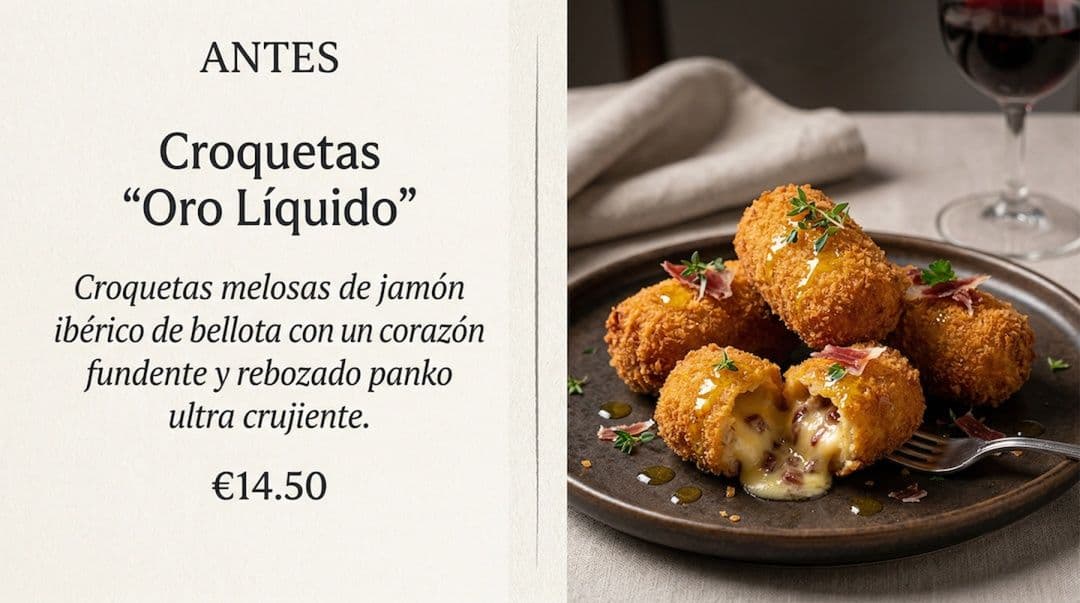
AI Dish Photos for Restaurants: Do They Actually Work?
Open the menu of your favorite restaurant. Does it have photos? If it does, pay attention to what you order: you’ll almost certainly choose a dish you’ve seen an image of rather than one you’ve only read about.
It’s no coincidence. A hospitality industry study estimates that menu items with photos are ordered up to 30% more than those with text only. And if we’re talking about tourists who don’t understand the language, a photo isn’t just an extra—it’s the only way they know what they’re going to eat.
The problem is that most restaurants don’t have professional photos of their dishes. And the reasons are always the same: a food photographer charges between €300 and €500 per session, every time you change the menu you need another session, and ultimately, the average restaurant simply can’t afford it.
This is where artificial intelligence comes in. But before we get ahead of ourselves, let’s see what it can actually do, what it can’t, and who it makes sense for.
What exactly are AI-generated dish photos?
When we talk about AI dish photos, we aren’t talking about looking for an image in a stock photo library. It’s something different.
The AI receives the name of the dish and its description (for example: "Grilled salmon with seasonal vegetables and lemon sauce") and generates an original image from scratch. It is not a real photo. It is an image created specifically to represent that dish, with a professional visual style, good lighting, and careful presentation.
The result looks very similar to the photos you would see in a food magazine or on a high-end restaurant's website. And it is generated in seconds, not hours.
The real advantages for a restaurant
The first advantage is obvious: the cost. If a food photography session costs €300–€500 and you need to repeat it every time you change the menu, we’re talking about an annual expense of at least €600–€1,500. With AI, the cost is reduced to practically zero per image.
The second is speed. If you add a new dish to your menu tomorrow, you don’t need to call the photographer, coordinate schedules, and wait. The photo is generated instantly.
The third, and the one few people mention, is visual consistency. When a restaurant takes homemade photos with a mobile phone, every image has a different light, a different angle, a different background. The result is a menu that looks like a collage. With AI, all images maintain the same style, the same quality, and the same aesthetic. Your menu looks professional from start to finish.
And the fourth is especially relevant if your restaurant receives tourists: a menu with photos drastically reduces the language barrier. A German tourist who doesn't speak Spanish might not understand what "pulpo a feira" is, but if they see the photo, they’ll order it. Without a photo, they order chicken.
The limitations no one tells you about
It would be dishonest to say that AI photos are perfect. They are not, and it’s important to know where they fail.
The most obvious limitation is that the photo is not your exact dish. It is a visual representation of a dish that fits the description, but it is not a photograph of what comes out of your kitchen. For many restaurants, this isn't a problem—the image fulfills the function of showing the customer what kind of dish it is and whetting their appetite. But for a fine-dining restaurant where the presentation of the dish is part of the experience, you’ll probably want real photos.
The second limitation is that very specific or regional dishes may not be represented with total accuracy. If your specialty is a traditional stew from your grandmother with a very particular presentation, the AI is going to generate something generic that looks similar, but isn't exactly that. For universal dishes (burgers, pizzas, salads, rice dishes, grilled meats), the result is very good. For very local dishes, it depends.
The third: some customers, especially younger ones familiar with AI, may notice that the photo is not real. In most cases, this doesn't affect the purchase decision—the photo still fulfills its function of showing the dish. But it is something to keep in mind.
Who does it make sense for?
After analyzing how these tools work with real restaurants, the profile where AI photos provide the most value is quite clear.
Yes, it makes a lot of sense if:
- Your menu currently has no photos and works only with text.
- You receive tourists who don’t speak your language.
- You don’t have a budget for a professional photographer every time you change the menu.
- You change your menu frequently (seasonal menus, daily specials).
- You want your digital menu to look professional without investing hundreds of euros.
It’s probably not for you if:
- You are a fine-dining restaurant where the presentation of the dish is part of the value proposition.
- You already have a photographer who does regular sessions and you are happy with the result.
- Your menu changes very little and you already have professional photos of all the dishes.
The photo doesn't sell alone, but without a photo, you don't sell
There is one figure that summarizes why this matters: in tourist areas like the Costa del Sol, where 58% of restaurant bookings are from foreigners, the menu is the first and often the only point of contact between the restaurant and the customer. If that menu is a PDF without photos in a single language, you are leaving money on the table.
The AI photo is not the solution to all a restaurant's problems. But if the alternative is having no photos at all, the difference between a dish with an image and one without an image is, literally, whether the customer orders it or passes it by.
And that, multiplied by the dozens of dishes on a menu and the hundreds of tourists who pass through each week, is a lot of money.
How to try it without commitment
If you want to see how the photos of the dishes on your menu would look, you can upload your current menu and see the result in less than a minute. No registration, no card, no commitment.