How Much Does Reprinting Your Restaurant Menu Actually Cost Per Year (and How to Stop Doing It)
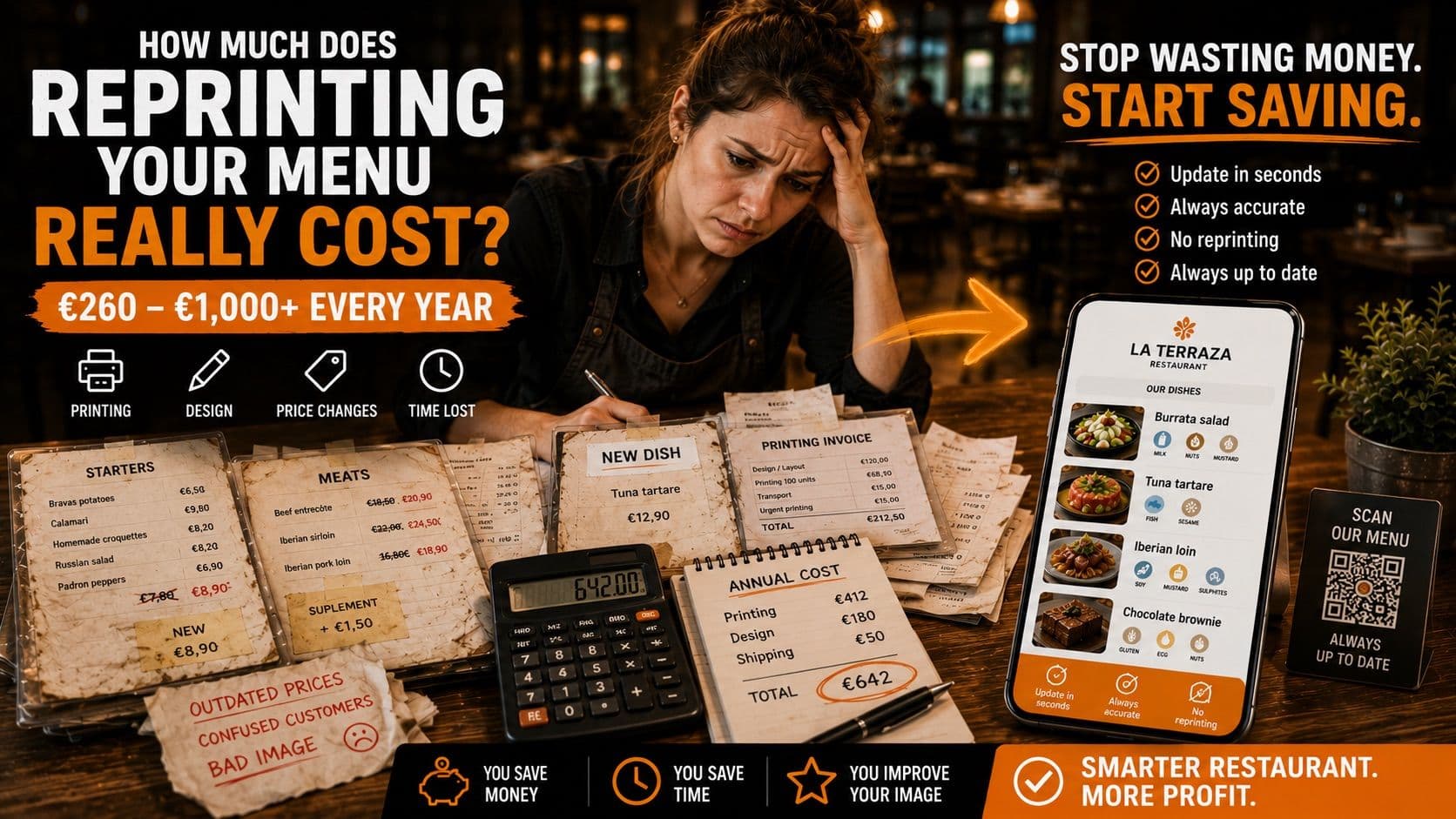
How Much Does Reprinting Your Restaurant Menu Actually Cost Per Year (and How to Stop Doing It)
No restaurant owner sits down at the end of the year and adds up what they spent reprinting menus. It never shows up as one big line item. It is 50 here, 80 there, a design change for this, a rush order for that. Small amounts that repeat every few months and, when you finally add them up, hurt a lot more than you expected.
In this article we are going to do the math with real printing prices, no inflating, so you can see what keeping your menu on paper is actually costing you per year. And then we will look at the alternative that makes the whole expense disappear.
The actual printing numbers
Let us start with the data, because the first problem is that most restaurant owners have not looked at printing prices since the last time they placed an order — and when they did, they probably did not compare.
Printing the menu (not counting design):
- Basic laminated menus (letter size or half letter, two sides): between $20 and $50 per batch of 25-50 units, depending on paper weight, lamination, and printer.
- Folded and stapled booklet-style menus (8-16 pages): from $30 per 100 units in basic formats, up to $120 or more on premium paper with special finishes.
- PVC or synthetic paper menus (washable, the most durable): from $45-70 per batch of 25.
Graphic design (if you hire a professional):
- A simple layout update at an online print shop (template + your content): between $50 and $130.
- A custom design from a freelance graphic designer: between $250 and $600 depending on complexity.
- Premium designs with professional photography, special inks, or artisan paper: from $600 to well over $1,500.
Turnaround time:
- Online print shops: 3-5 business days for standard shipping, 24-48 hours for rush orders (with a surcharge).
- Designer + traditional printer: 7-15 days if there are rounds of corrections.
These are reference prices in 2026. They vary by printer, quantity, and finish, but they give you the order of magnitude.
Now the math nobody does: the annual cost
Here is where it changes. Because everything above is the cost of one reprint. The question that matters is: how many times a year do you reprint?
The industry recommendation is to update the menu at least once a year to adjust prices for inflation. Many restaurants do it twice (summer and winter), and those working with seasonal produce do it up to four times a year with each season change.
But that is just the planned updates. Then there are the unplanned reprints — and those are the ones that really sting:
- Ingredient cost spikes. Oil goes up 20%, seafood prices jump, and your menu prices no longer make sense. Either you reprint or you cross things out with a pen.
- Supplier or ingredient change. Your usual bread is out of stock and the replacement contains sesame. Time to update the allergen information.
- Worn or damaged menus. Depending on the material, laminated menus last a few months; plain paper ones, weeks. Cardboard menus on a sunny terrace, sometimes days.
- New dish or removed dish. You want to drop a low-seller and add something new. You have to reprint or stuff in a loose insert.
- Peak season. You run out of menus because you have more tables set up than usual. Rush order.
Now let us do the math for a typical restaurant. Being conservative:
Minimum scenario (1 planned update + 1 unplanned reprint per year):
- Design/layout for the update: $50-100
- 2 print runs per year: $40-80 each
- Annual total: $130-260
Realistic scenario (2 planned updates + 2-3 unplanned reprints):
- Design/layout: $100-200 per year
- 4-5 print runs: $40-80 each
- Annual total: $260-600
Seasonal restaurant or tourist-area restaurant (4 updates + several unplanned reprints):
- Design: $200-400 per year
- 6-8 print runs: $40-80 each
- Annual total: $440-1,040
And this does not include the cost of designing the menu from scratch if you open a new location or do a major overhaul — which can be $250 to over $1,000 in design alone.
Is that a lot of money? For a business operating on 3 to 6 percent net margins, every dollar matters. And the worst part: that expense never stops. Every year, the same hundreds of dollars. It is a recurring cost disguised as a one-time expense, and that is why almost nobody sees it.
The cost that does not appear on the printer's invoice
But the money is not even the worst part. The worst part is what it costs you in time and image — and that never shows up on any invoice.
The time. Every reprint involves: reviewing the entire menu, sending the file to the designer or printer, waiting for proofs, correcting, approving, waiting for delivery, distributing the new menus across all tables. In a restaurant where the owner works 14-hour days, that process eats an entire afternoon. And an afternoon during peak season is worth far more than the printing cost.
The image in the meantime. What happens between changing a price and receiving the new menus from the printer? A minimum of 3-7 days pass. During those days, your menu either shows the old price (and you have to explain it at every table) or has a crossed-out number with a handwritten correction (and looks like a roadside diner). There is no good option. Both cost you professionalism.
The inserts and patches. The classic solution of "I'll print a small slip and clip it inside" or "I'll tape a sheet onto the menu." Every restaurant owner has done it. Every restaurant owner knows it looks terrible. And yet they keep doing it because the alternative is reprinting the whole thing. That patch, which seems free, is costing you in perceived quality every time a customer sees it.
The obvious question: is there a way to never reprint again?
Yes. And it is not some futuristic technology — it is a digital menu with a QR code.
The logic is simple: if your menu lives on a screen instead of on paper, changing a price or hiding a sold-out dish takes ten seconds from your phone. There is no designer, no printer, no waiting, no printing cost, no insert taped with adhesive. You make the change and instantly every customer who scans the QR sees the updated menu.
"Sure, but QR menus..." If you are thinking that QR codes annoy customers or look cheap, we wrote a separate article on whether QR menus are actually worth it — with the real downsides included. The short version: a QR that opens an unreadable PDF is annoying. A QR that opens a well-built menu with photos, translations, and a mobile-first design is a different experience entirely. And you can always keep a few paper menus around for whoever prefers them.
What I can guarantee you with numbers is this: if your restaurant spends between $260 and $600 a year on reprinting (the realistic scenario), a digital tool that costs $25-50 per month already costs less than paper, even without counting the time savings or the image improvement. And next year you do not pay the $600 again. Or the year after that.
Besmeo: your menu always up to date, no printer needed
With Besmeo, you upload your existing menu as a PDF or photo and the tool extracts the dishes and prices, generates a photo for every dish, translates the menu into your customers' languages, and delivers a mobile-first digital menu with your branding and a QR code ready to print.
From that point on, every time you need to change something — a price, a sold-out dish, a new ingredient, the entire seasonal menu — you do it yourself from your phone in seconds. The QR code on your tables stays the same. There is no printer, no waiting, no extra cost. The change is live for all customers instantly.
And if you are in a tourist area, the automatic translation saves you a second cost that almost nobody counts: translating the menu every time you update it, which with a professional translator runs another $50-150 per language, per update.
You can try it free with your own menu and see the result before committing to anything:
👉 Create your digital menu at besmeo.com
Conclusion
The real cost of keeping your menu on paper is not the $50 for one print run. It is the sum of every reprint over the year, plus the design work, plus the days with a crossed-out menu, plus the afternoons lost dealing with the printer, plus the image you lose every time a customer sees a patched-in insert. For a typical restaurant, that is between $260 and over $1,000 a year, every year, without ever stopping.
A digital menu eliminates that cost at the root: change whatever you want, whenever you want, from your phone, and the QR on the tables never moves. If you want to see what yours would look like, upload your menu at besmeo.com/create-your-menu and check it out in minutes.
Frequently asked questions
How much does it cost to print restaurant menus? It depends on the format and quantity: a batch of 25-50 laminated menus costs between $20 and $80 for printing alone, not counting design. Design can add between $50 and over $500 depending on complexity.
How often do restaurants need to reprint their menus? At least once a year to adjust prices. Most restaurants reprint 2-4 times a year for seasonal changes, plus unplanned reprints for price spikes, sold-out items, or damaged menus.
How much does a restaurant spend on menus per year? A typical restaurant with 2 planned updates and a few unplanned reprints spends between $260 and $600 annually. Seasonal restaurants or those in tourist areas can exceed $1,000.
Is a digital menu cheaper than reprinting? In most cases, yes. A digital tool at $25-50 per month costs less per year than the cycle of design, printing, and distribution — and eliminates the time and image costs that paper generates.
Can I have both a digital menu and paper menus? Yes, and it is the smartest approach. The digital menu handles updates and languages; a few paper menus cover customers who prefer them. What you no longer need is reprinting 50 menus every time you change a price.