How to Translate Your Restaurant Menu (Without using ChatGPT)
How to Translate Your Restaurant Menu (Without using ChatGPT)
Initial Definition: Translating a restaurant menu involves adapting your culinary offerings into different languages so that international guests understand ingredients and preparation methods. It is not just about changing words, but about conveying the value, culture, and appeal of each dish without losing its original essence.
I know exactly what your day-to-day is like. You arrive before the streets wake up, check that the produce from your supplier is perfect, organize the staff shifts, balance the books from the day before, and suddenly, your terrace is packed. In the midst of that daily whirlwind, that controlled chaos of running a restaurant business, high season arrives. And with it, tables fill up with guests who don't speak a single word of Spanish.
You and I both know what happens next. The waiter approaches the table with their best smile, but communication is impossible. There are gestures, looks of confusion, and fingers pointing randomly at a paper they don't understand. In the end, the guest ends up ordering a basic burger or fries because that’s the only thing they could decipher.
If you’ve been in this situation, you should know that you are losing a lot of money every single day. The language barrier in the hospitality industry is not just a communication problem; it is a hole through which sales of your most profitable dishes, your specialties, and your best wines are escaping. In this article, we are going to talk straight—from one restaurant owner to another—about how to solve this and how to translate your restaurant menu professionally without having to spend a fortune on agencies or sworn translators who, let's be honest, don't know the soul of your kitchen.
The Great Tourist Problem: Why They Always Order the Cheapest Item
Let’s put ourselves in the shoes of that German, British, or Nordic tourist who just sat down on your terrace. They come looking to enjoy themselves, have a decent budget to spend on their vacation, and want to try authentic local gastronomy. They sit down, pick up your menu, and encounter a wall of text in a language they don't know.
Human psychology in situations of uncertainty is simple: when faced with the unknown, we seek safety. And on a restaurant menu, safety is what we recognize. If a tourist reads "Croquetas de puchero" (stew croquettes) and there is no translation or clear explanation, their brain doesn't take risks. Instead of going for that dish that gives you a fantastic profit margin and that they would love, their eyes drop down the menu until they find universal words: Pizza, Burger, Chips, Salad.
The result is doubly bad. On one hand, the tourist leaves with a mediocre gastronomic experience, thinking your place only serves basic fast food. They won't leave a memorable review or recommend you to their hotel. On the other hand, your average check plummets. You’ve lost the opportunity to sell them that piece of hake, that ribeye steak, or that traditional stew you have in the kitchen and feel so proud of.
Having a multi-language menu is not a decorative luxury to impress; it is a top-tier sales tool. It is the difference between billing $30 per diner or $15. When the customer understands what they are about to eat, when they read an appetizing description that makes them salivate in their own language, price takes a backseat and the experience takes control. The tourist doesn't order the cheap stuff out of stinginess; they order it out of fear of making a mistake. Your job—and your menu’s job—is to take that fear away.
The Trap of Local Gastronomy: Traditional Dishes and the Danger of Literal Translation
This is where most restaurants make the most catastrophic mistake. Knowing they need an English menu, they go online, copy their menu text, paste it into a decade-old free translator, print the result, and laminate it. The disaster is served.
Spanish cuisine is rich, complex, and deeply cultural. We don't have generic dishes. We have recipes with history, and those stories cannot be translated word-for-word. Let's look at three classic examples of dishes that are absolute death traps if translated literally.
1. The Mystery of "Gildas"
Gildas are trendy. This wonderful Basque pintxo is the perfect appetizer for any bar worth its salt. Olive, chili pepper, and anchovy, all joined by a toothpick and bathed in good olive oil. What happens if you put "Gilda" into an automatic translator? The tourist will read the name of a Rita Hayworth movie and have no idea if it’s meat, fish, or dessert.
It doesn’t help to translate it as Spicy green pepper skewer, because you strip away all the charm and value. A good, adapted translation that keeps the identity intact would keep the original name and add an appetizing description: Gilda (Traditional Basque Skewer with anchovy, mildly spicy green pepper, and olive). Now the tourist knows what it is, what ingredients are in it, and understands it's something traditional. Sold!
2. "Callos": How to Scare a Customer in Three Seconds
Callos (tripe stew) are a gift from the gods for us. That gelatinous texture, that sauce for dipping half a loaf of bread, that touch of paprika. But let’s be very honest: if you tell a British tourist they are about to eat "cow stomach," they will run out of your place and never look back.
If you use a basic system that translates Callos as Cow stomach or Tripe without further context, you are killing the dish. A tourist isn't used to offal the same way we are. You need a translation that sells the process, the care, and the flavor of the dish, not just its anatomy. Something like: Traditional Slow-Cooked Beef Stew with Chorizo and Smoked Paprika (Callos). It sounds like a comforting spoon dish, cooked low and slow, rooted in tradition. It completely changes the perception.
3. The "Pulpo a la Gallega" and the Raw Octopus Syndrome
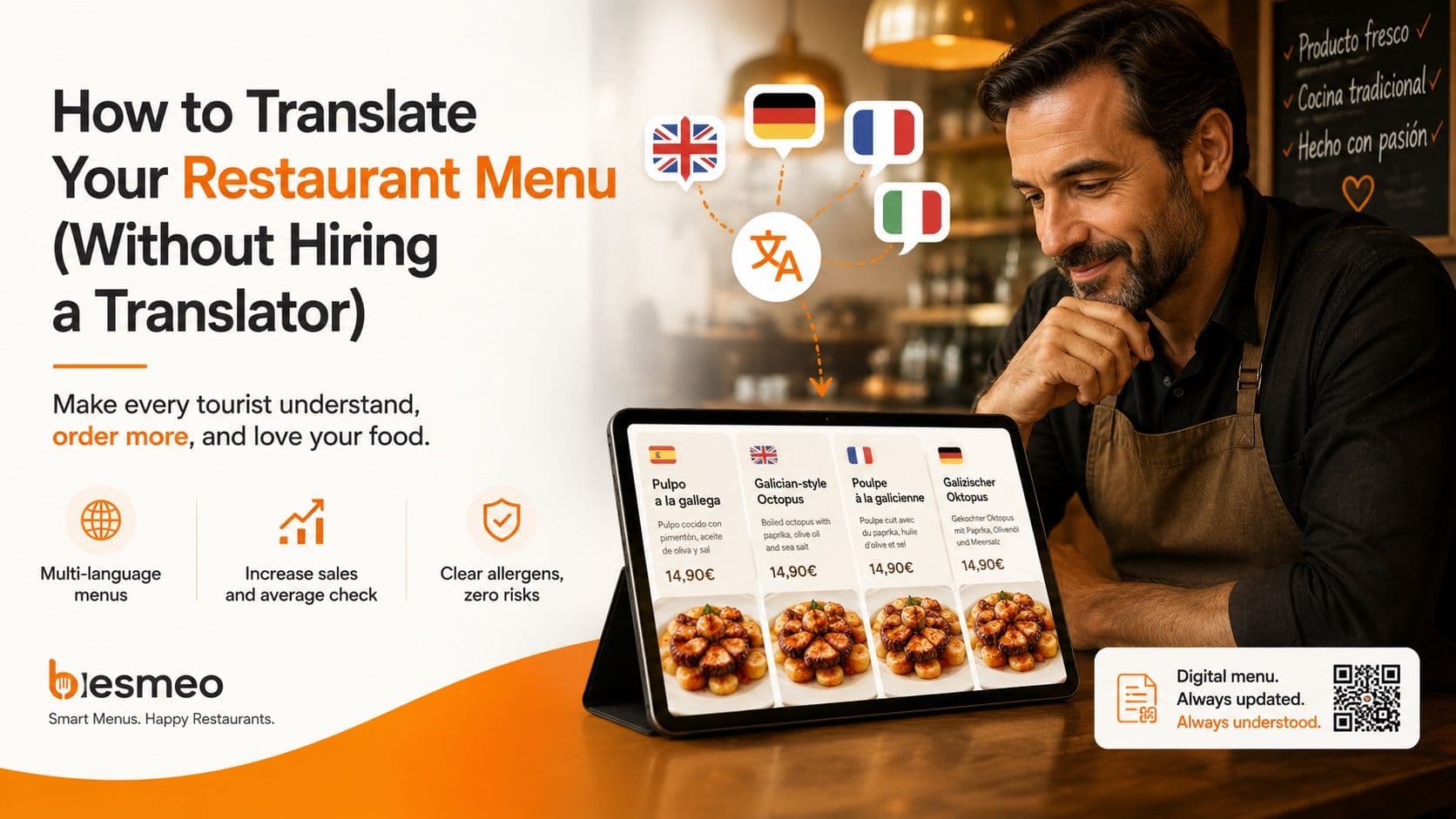
Another classic on our chalkboards. Pulpo a la gallega (Galician-style octopus) is sacred. The problem is that "Galician-style" means nothing to a gentleman from Wisconsin. If you translate it as Galician style octopus, the guest still doesn't know what you’re putting on their plate. Is it fried? Is it raw? Is it spicy? Is it whole?
The correct translation of this dish must describe what the customer will see and taste. It must evoke that bed of potatoes, the glistening oil, and the red touch of paprika. The ideal adaptation would be: Tender Octopus Slices on a bed of potatoes, drizzled with Extra Virgin Olive Oil and Smoked Paprika (Pulpo a la gallega). By reading "tender," you take away the fear of it being rubbery. By reading "smoked paprika," you prepare them for the flavor.
The goal is never to erase the Spanish name. Tourists want to learn new words, they want to order a "Pulpo" or "Gildas," but they need the lifebuoy of the description in their own language to dare to do so.
The Most Common (and Dangerous) Translation Ridicules
The hospitality sector is full of hilarious anecdotes about bad translations, but when your business is at stake, the humor disappears quickly. A poorly translated menu damages your restaurant's image. It conveys carelessness. If the owner hasn’t bothered to check how what I’m about to eat is spelled, the customer will think, who knows how clean the kitchen is.
You’ve surely seen on social media images of menus where "Vino en botella" (Wine in a bottle) was translated as "He came in a bottle" (due to the confusion of the verb venir in the past tense). Or the classic "Angry potatoes" for Patatas bravas. These atrocities happen when you blindly trust generic tools that have no gastronomic context. Languages are full of idioms, double meanings, and local slang. A system not specifically designed for hospitality won't know the difference between bonito as a fish (tuna) and bonito as something beautiful, and you might end up offering "Beautiful with tomato" instead of "Tuna with tomato." You cannot leave your restaurant’s reputation to chance.
The Critical Barrier: Translating Allergens is a Life-or-Death Matter (Mandatory Human Review)
Until now, we’ve talked about sales, marketing, making dishes sound appetizing, and avoiding embarrassment. But there is one section of your menu where the jokes end abruptly, and where legal responsibility and public health come into play: the allergen chart.
European regulations and local legislation are absolutely strict regarding food information provided to the consumer. If an international guest is allergic to peanuts, shellfish, or gluten, and your translated menu contains an error in this section, you face a potential medical emergency in the middle of your dining room and severe legal consequences that could lead to the closure of your business.
This is where technology always, I repeat, ALWAYS needs the oversight of a human. Even if you use the best system in the world to generate your multi-language menu, allergens cannot be left to free interpretation.
Imagine your menu indicates "Tree nuts." A bad system might translate it as Shell fruits, which means nothing in English and could be confused with seafood shells. The correct medical and hospitality term is Tree nuts. If you have a dish with "Traces of sesame," you cannot risk the translation omitting it or mistranslating it.
Golden Rules for Allergen Translation:
- Don't use synonyms: When it comes to food, always use terms standardized by international legislation (Gluten, Crustaceans, Eggs, Fish, Peanuts, Soybeans, Milk, Nuts, Celery, Mustard, Sesame, Sulphites, Lupin, Molluscs).
- Universal Iconography: Always accompany the translation with international allergen icons. A drawing of a crossed-out wheat stalk is understood in China, Russia, and the US.
- Clear Warnings: Always add a footer in the main languages (English, French, German) that says something like: "If you have any allergies or dietary restrictions, please inform our staff before ordering."
- The Final Review: Once you have your translated menu, sit down with your head chef. Review it dish by dish, ingredient by ingredient. Ensure that what the English menu says corresponds 100% to what is in the pan.
If you have doubts about how to legally and operationally manage this in your venue, I recommend you take a deep look at our dedicated article. Don't gamble here: Read our complete guide on how to declare and manage allergens on your menu.
How to Achieve a Perfect Multi-Language Menu Without Breaking the Bank
At this point, as a distrustful (and rightly so) restaurant owner who cares about every cent that comes out of the cash register, you might be asking: "Okay, you’ve convinced me. I can't use a free internet translator and I can't make a fool of myself with tourists. But hiring a professional translation agency is going to cost me hundreds every time I want to change the seasonal menu or the price of the sirloin. What do I do?"
That has been the historic frustration of the sector. You either paid a lot of money and had a rigid menu that was a nightmare to update, or you did it yourself in a Word doc and it looked amateurish. Fortunately, today you don't need either. Current technology allows you to have the best of both worlds: the quality of a translator who understands gastronomy and the agility of being able to change a price or a dish in a matter of seconds, without relying on third parties.
The secret is to use technology designed exclusively for hospitality. Tools that already know what a Gilda is, that understand how to cook a Rabo de toro, and that are trained to generate appetizing, correct, and sales-focused descriptions.
The Ultimate Solution for Your Restaurant: Besmeo
If you want to stop losing money with tourists, if you are tired of seeing people order a "mixed salad" while you have spectacular clams, and if you want to get rid of the headache of translations forever, you need to integrate Besmeo into your daily routine.
Besmeo is not a generic translator. It is an intelligent SaaS platform created to digitize and optimize restaurant menus. We understand that your time is gold and that you don't want to spend hours setting up complicated software. That is why we made it absurdly easy.
How does it work? You don't have to re-type your menu. You just have to upload your current PDF to the system. Besmeo reads it, recognizes your dishes, understands the gastronomic context of your offer, and digitizes it automatically. And if you don't even have a PDF handy, no problem: you can take a photo of your paper menu directly with your phone, and our system takes care of the rest.
Once inside, Besmeo translates your menu instantly into the languages you need (English, French, German, Italian, etc.), adapting the tone so your dishes sound irresistible and avoiding disastrous literal translations. Furthermore, it allows you to modify prices, hide dishes that have run out in the kitchen, and manage your allergens clearly, so you always have absolute control. Everything is updated in real-time via an elegant QR code that guests scan at their table.
You don't need to be a tech expert. If you know how to take a photo with your phone or attach a file, you know how to use Besmeo. It is the peace of mind knowing that every foreigner who steps into your place will understand perfectly why your dishes are the best in the neighborhood, increasing your average check from minute one.
Take the step today and stop losing sales at every tourist table.
Start digitizing and translating your menu right now with Besmeo
Ready to digitize your restaurant?
Create my menuFrequently Asked Questions (FAQs) About Menu Translation
How much does it really cost to translate a restaurant menu? If you hire a professional human translator or an agency, the cost is usually calculated by word. An average menu with descriptions can cost you between $150 and $300 per language. The big problem with this method is maintenance: every time you change from the summer to winter menu, or simply modify prices due to inflation, you will have to pay them again. Using platforms specialized in hospitality like Besmeo, this cost disappears, as dynamic translations are included in your monthly subscription, allowing you to change the menu a hundred times a day if you need to without paying a cent extra.
How many languages should I translate my menu into? As an absolute minimum, your menu should be in the local language and English. English acts as a bridge language; even if a tourist is Norwegian or Japanese, they will most likely be able to get by in English. From there, you should analyze your clientele. If you are in a high-tourism area, German or French are essential. With a digital menu, you don't have space limitations (as you do with paper), so offering 4 or 5 main languages is ideal to cover almost any eventuality.
What happens if I run out of a dish halfway through service and it’s on the menu in several languages? This is the biggest problem with translated paper menus. If you have your physical menu in English and you run out of sea bream, the waiter has to go table by table, in a language they don't master, explaining that there is no sea bream. With an intelligent digital menu, you simply take out your phone, hide the dish with one button, and it automatically disappears from the menus in Spanish, English, French, and German. Problem solved in two seconds, with no interruptions to the service.
Can Artificial Intelligence replace a sworn translator? For legal documents (contracts, deeds), no. But for a restaurant menu, specialized AI (not generic free translators) is faster, much cheaper, and often more effective at selling the product because it is programmed to write appetizing descriptions. However, as we have emphasized in the article, the allergen section must always have meticulous human review by the manager of the venue to guarantee total safety for diners.