Restaurant Menu Pricing: How to Set Prices That Actually Maximize Profit
Restaurant Menu Pricing: How to Set Prices That Actually Maximize Profit
You can have the best food in town and still lose money. It happens all the time. A restaurant packed every night, customers raving on Yelp, and the owner wondering why the bank account doesn't reflect the buzz.
Nine times out of ten, the problem is the menu pricing.
Most restaurant owners price their dishes one of two ways: they copy what the restaurant down the street charges, or they pick a number that "feels right." Both approaches leave money on the table — sometimes thousands of dollars every month.
This guide gives you the actual formulas, frameworks, and psychology behind menu pricing that works. No theory, no fluff. Just the math and strategy you need to make your menu more profitable starting this week.
The only formula you actually need to start
Before anything else, you need to know your food cost percentage for every dish on your menu. This is the foundation of everything.
The formula is simple:
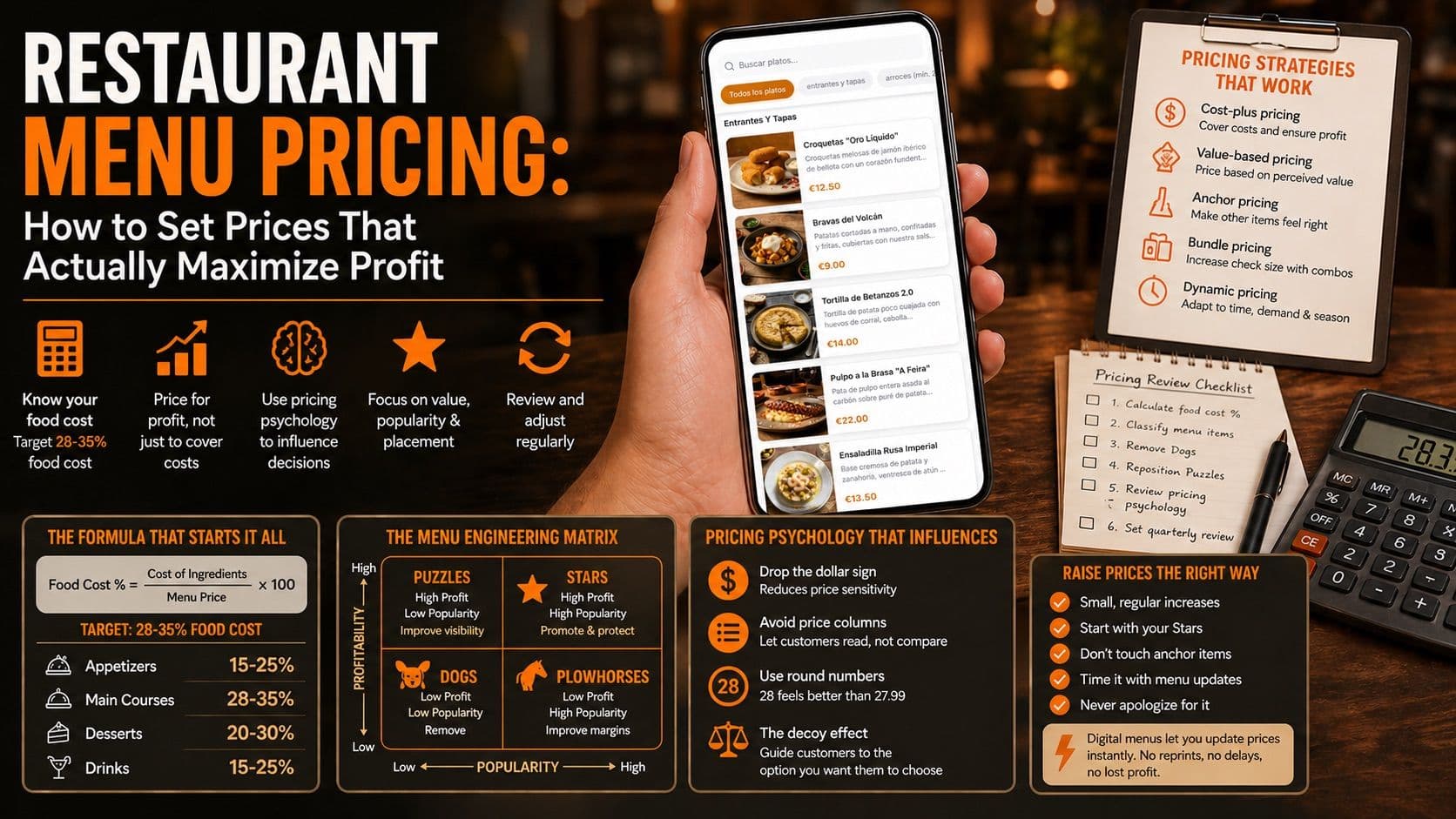
Food Cost % = (Cost of Ingredients / Menu Price) × 100
If a dish costs you $7 in ingredients and you sell it for $22, your food cost percentage is 31.8%. That's within the healthy range.
The target for most restaurants is 28-35% food cost. That means for every dollar a customer pays, you're spending 28 to 35 cents on ingredients. The rest covers labor, rent, utilities, and — if you've priced well — profit.
Here's what those ranges typically look like by category:
- Appetizers: 15-25% food cost. These should be your highest-margin items. A $13 appetizer that costs you $2 in ingredients is a 15% food cost — that's a money printer.
- Main courses: 28-35% food cost. This is where most of your volume lives. Keep it tight here and the rest of the menu can breathe.
- Desserts: 20-30% food cost. Similar to appetizers — low ingredient cost, high perceived value.
- Drinks: 15-25% food cost. Beverages are consistently the highest-margin category in any restaurant. A cocktail that costs $2 to make and sells for $14 is a 14% food cost.
If you have dishes above 35%, they're eating into your margin. Either raise the price, reduce the portion, swap an expensive ingredient, or remove them from the menu.
The menu engineering matrix: your profit map
Once you know the food cost of every dish, you need to understand which items are actually driving your profit and which ones are dragging it down. This is where the menu engineering matrix comes in.
Every item on your menu falls into one of four categories based on two factors: how profitable it is and how popular it is.
Stars are high profit and high popularity. These are your best items. They make you money and customers love them. Protect these at all costs. Put them in the Golden Triangle on your menu (center, top right, top left). Never bury a Star at the bottom of a section.
Plowhorses are low profit but high popularity. Customers order them a lot, but you don't make much on each one. The classic example is a best-selling burger that costs you $8 to make and sells for $14 — popular, but thin margin. The fix: small price increases (most customers won't notice $1-2), reduce the portion slightly, or swap one expensive ingredient for a cheaper alternative without changing the dish's identity.
Puzzles are high profit but low popularity. These dishes make you great money when someone orders them, but nobody does. The fix isn't removing them — it's making them more visible. Better menu placement, better descriptions, a "Chef's Pick" tag, or a photo can turn a Puzzle into a Star.
Dogs are low profit and low popularity. Nobody orders them and when they do, you barely make money. Remove them. Every Dog on your menu takes up space that could be used by a Star or a Puzzle. If a dish hasn't sold well in 3 months and doesn't make you good money, it's gone.
Review your menu through this matrix at least once a quarter. Your Stars and Dogs will change with seasons, ingredient costs, and customer preferences.
Five pricing strategies that actually work
1. Cost-plus pricing (the baseline)
This is where you start. Take your ingredient cost, multiply by 3 to 4, and that's your menu price. A dish that costs $6 in ingredients gets priced at $18-24.
The multiplier depends on your restaurant type: fast casual can get away with 3x because of volume, while fine dining often uses 4x or higher because of lower volume and higher overhead.
This method is simple and ensures you cover costs, but it's just the starting point. Pricing every item at exactly 3x is lazy and leaves money on the table because some items have more perceived value than others.
2. Value-based pricing (the upgrade)
Some dishes are worth more than their ingredients suggest. A hand-rolled pasta that costs $5 to make might justify a $28 price tag because customers perceive the craftsmanship, the time, the technique. A simple grilled chicken breast with the same $5 ingredient cost probably can't command $28.
Value-based pricing means charging what the experience is worth, not just what the ingredients cost. Signature dishes, unique preparations, and items you're known for can be priced above the standard multiplier because customers are paying for more than just food.
3. Anchor pricing (the psychology)
Put an expensive item near the top of each section. A $48 tomahawk steak makes the $28 salmon look reasonable by comparison. Without the steak, that salmon feels expensive. With it, it feels like a deal.
This isn't about actually selling the $48 steak (though it's great when you do). It's about making everything else on the menu feel fairly priced. The anchor item shifts the customer's perception of what's expensive and what's affordable.
4. Bundle pricing (the check builder)
"Add a side and a drink for $5" sounds like a deal to the customer. But if that side costs you $1 and the drink costs you $0.75, you just made $3.25 in extra profit on a table that might have ordered nothing else.
Combo deals, prix fixe menus, and "complete your meal" add-ons work because customers feel like they're getting value, while you're increasing the average check with high-margin additions.
5. Dynamic pricing (the modern approach)
This isn't surge pricing. It's what you're already doing with lunch specials and happy hour — you just might not think of it as a pricing strategy.
Offering a $15 lunch menu when your dinner entrées are $28 fills seats during slow hours and brings in customers who might not come at dinner prices. Early bird discounts, weekday specials, and seasonal pricing are all forms of dynamic pricing that let you maximize revenue across different time slots and seasons without alienating anyone.
The psychology of pricing that most owners ignore
Small changes to how prices appear on your menu can shift customer behavior more than the actual dollar amounts. These aren't tricks — they're well-researched principles that the most profitable restaurants use.
Drop the dollar sign
When customers see "$28.00" their brain registers "spending money." When they see "28" the price becomes just a number. Research consistently shows that removing the dollar sign reduces price sensitivity. Customers order more freely when the currency symbol isn't staring at them.
Avoid price columns
If your prices are neatly aligned in a column on the right side of the menu, customers will scan down that column comparing numbers instead of reading your descriptions. The cheapest item wins by default.
Instead, place the price at the end of the description in the same font size. "Pan-seared Atlantic salmon with seasonal vegetables and lemon butter... 28" — the eye reads the description first and hits the price second.
Use round numbers
$28 feels more confident than $27.99. The .99 trick signals "we're trying to make this seem cheap" which works for fast food but undermines perceived quality in a sit-down restaurant. Round numbers communicate confidence in the value of your food.
The decoy effect
If you want to sell more of your $22 chicken dish, put a slightly less appealing option at $20 and a premium option at $30. The $22 dish becomes the obvious "smart choice" — better than the basic option but not as expensive as the premium one.
When and how to raise prices without losing customers
Most restaurant owners delay price increases far too long. They're afraid of customer backlash, so they absorb rising costs until their margins are razor-thin. By the time they finally raise prices, they have to make a big jump that actually does shock customers.
The better approach: small, regular increases. Raising prices by 2-3% twice a year is far less noticeable than a 6% jump once a year, even though the end result is the same.
Here's how to do it without causing pain:
Start with your Stars. These are high-popularity, high-profit items. Customers already love them. A $1-2 increase on a Star is unlikely to change ordering behavior because people aren't choosing it based on price — they're choosing it because they love it.
Don't touch your anchor items. If you have a known value item that brings people in the door (your famous $12 lunch special, for example), keep that stable. Raise prices on the items around it instead.
Time it with a menu update. Raising prices alongside a new seasonal menu, a redesign, or the addition of new dishes makes the increase feel like part of something bigger rather than a standalone "we're charging more now."
Never apologize for a price increase. Don't put a note on the menu saying "due to rising costs, we've had to adjust our prices." It draws attention to the increase and makes customers feel like they're paying for your problems. Just update the prices and move on.
And here's one that most restaurants don't think about: if you're using a digital menu, you can update prices instantly from your phone. No reprinting, no design costs, no delay. That means you can react to ingredient cost changes in real time instead of waiting months for a reprint and absorbing the loss in the meantime. Tools like Besmeo let you change any price in 10 seconds, and the QR code on your tables never changes — it always points to the latest version.
The hidden cost of not updating prices
This is where most restaurants silently bleed money.
Say your chicken supplier raises prices by 8%. Your grilled chicken dish now has a 38% food cost instead of 32%. You know you should raise the price, but your menus are printed and a reprint costs $200-400. So you wait until the next scheduled reprint in three months.
In those three months, if you sell 15 chicken dishes per day at a $2 margin loss per dish, you've lost $2,700 in profit. The reprint you were trying to avoid would have cost you $300.
This is the most compelling argument for digital menus over printed ones. Not the photos, not the translations, not the QR code — it's the ability to change a price on a Tuesday afternoon and have it live before the dinner service starts. Over a year, the speed of price adjustments alone can be worth thousands of dollars in preserved margin.
Putting it all together: a practical pricing review
If you've never done a structured pricing review, here's how to start this week:
Step 1: Pull up your menu and list every item with its ingredient cost and current price. Calculate the food cost percentage for each one. Flag anything above 35%.
Step 2: Classify every item using the menu engineering matrix. Which are Stars? Plowhorses? Puzzles? Dogs?
Step 3: Remove the Dogs. Reposition the Puzzles with better descriptions or placement. Slightly raise prices on Stars. Rework Plowhorses to improve their margin.
Step 4: Check your pricing psychology. Are dollar signs visible? Are prices in a column? Are you using round numbers? Fix what you can.
Step 5: Set a calendar reminder to repeat this review every quarter. Menu pricing isn't a one-time project — it's an ongoing process that directly impacts your profit every single month.
The restaurants that review their pricing quarterly and make small adjustments consistently outperform the ones that set prices once and forget about them. It's not glamorous work, but it's the difference between a restaurant that survives and one that thrives.
Make price changes instant
If reprinting your menu is what's stopping you from updating prices when you should, it's time to go digital. Upload your current menu and get a professional digital version you can update from your phone in seconds. No designer, no printer, no waiting.