Why Your Restaurant Needs a Multilingual Menu for Tourists
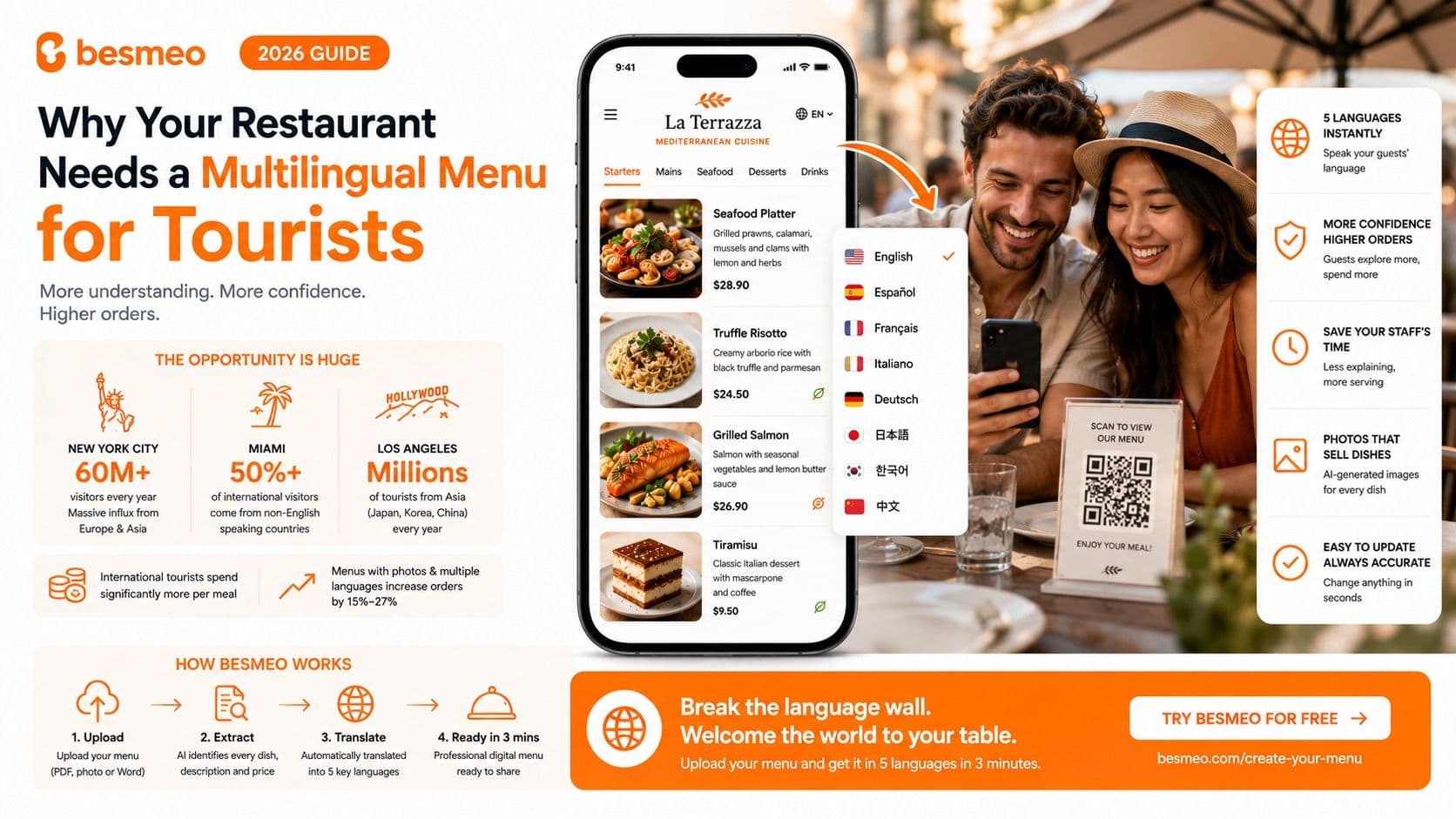
Why Your Restaurant Needs a Multilingual Menu for Tourists: The Definitive 2026 Guide
Every single day, thousands of restaurant owners in major tourist hubs like New York, Miami, and Los Angeles are leaving money on the table. It’s not because their food isn’t world-class, and it’s not because their staff isn't working hard.
It’s because of a silent, invisible barrier: The Language Wall.
When an international tourist sits at your table, scans a QR code, and finds a menu they can’t fully understand, their behavior changes instantly. They stop being adventurous. They stop looking for the "Chef's Special" or that high-margin seafood platter you’re famous for. Instead, they play it safe. They order a "burger" or "basic pasta" because those are universal words they recognize.
In this guide, we are going to break down why a multilingual menu isn’t just a "nice-to-have" anymore—it is a mandatory tool for increasing order value, improving operational efficiency, and capturing the massive spending power of global tourism in 2026.
1. The Trillion-Dollar Opportunity: By the Numbers
Tourism is the lifeblood of the hospitality industry, especially in the United States. According to the National Travel and Tourism Office (NTTO), international travel to the U.S. is projected to reach over 90 million visitors annually by 2027.
But where is that money going? Let’s look at the key hubs:
- New York City: Welcoming over 60 million visitors a year. With a massive influx from Europe (UK, France, Germany) and a recovering Asian market, an English-only menu ignores nearly 40% of the potential high-spenders.
- Miami: The true gateway to Latin America. Over 50% of its international tourists come from non-English speaking countries. If you aren't speaking their language, you aren't getting their business.
- Los Angeles & San Francisco: These cities are the primary hubs for tourists from Japan, Korea, and China.
The Economic Impact: Research shows that international tourists spend, on average, significantly more per meal than locals. Why? Because they are on vacation. They are in the "treat yourself" mindset. However, that spending only happens if they feel confident in what they are buying. Confidence is the currency of the tourist market.
2. Psychological Confidence = Higher Ticket Average
There is a direct, scientific correlation between comprehension and spending. When a guest reads a menu in their native language, two vital things happen:
A. Lower Anxiety
They aren't worried about ordering something they won't like, or worse, something they are allergic to. This "safety net" allows them to explore higher-priced items and complex dishes that they would otherwise avoid in a foreign language.
B. Sensory Engagement
"Grilled Chicken" is just a boring fact. "Poulet rôti aux herbes de Provence" is an experience. Sensory and descriptive language in a guest’s native tongue triggers an average 27% increase in sales. If your menu is only in English, a French tourist will see the "fact." If your menu is in French, they will feel the "experience."
3. Operational Efficiency: Saving Your Staff’s Time
Have you ever watched a server spend 10 minutes trying to explain what "Sea Bass" is to a group of tourists using hand gestures and broken sentences?
That is 10 minutes where:
- Other tables are being ignored.
- Drinks aren't being refilled.
- The "table turn" time is slowing down.
A multilingual digital menu acts as an invisible waiter. It handles the explanations, the allergen warnings, and the ingredient lists in the guest's language. This allows your staff to focus on what really matters: hospitality, fast service, and upselling, rather than acting as a human dictionary.
4. The Problem with the "Standard" Solutions
Most restaurants try to solve the language problem in three ways, and all of them are flawed:
- The Printed "Tourist" Menu: Usually a dusty, laminated binder with greasy pages. It looks cheap, it’s hard to update, and it makes the tourist feel like a "second-class" guest compared to the locals.
- The Google Translate "Pinch-and-Zoom": The guest opens your PDF menu and uses an app to translate. The result? "Garlic Prawns" becomes "Aromatic Sea Fingers." It’s visually messy, inaccurate, and destroys the brand image you’ve worked so hard to build.
- Hiring Translators: Costly and painfully slow. If you change a single price or add a seasonal dish, you have to pay the translator again and wait days for the update.
5. Besmeo: The 3-Minute Multilingual Revolution
This is where Besmeo is changing the game for restaurant owners. We realized that you don't have time to be a linguist or a tech expert. You need a solution that works as fast as your kitchen.
Besmeo is a digital menu platform that uses advanced Gastronomic AI to handle translations automatically.
How it works:
- Upload: You upload your existing menu (PDF, photo, or Word doc).
- Extract: The AI identifies every dish, description, and price.
- Translate: The moment your menu is uploaded, it is automatically translated into 5 key languages.
- Accuracy: Unlike generic translators, Besmeo understands culinary terms. It knows the difference between a "confit" and a "stew" and translates them with gastronomic precision.
By the time you've finished your morning coffee, you have a professional, high-end digital menu ready to be scanned by guests from around the globe.
6. Beyond Translation: The "Invisible" SEO Benefit
When you offer a multilingual digital menu, you aren't just helping the guest at the table; you are attracting the guest who hasn't arrived yet.
Today’s tourists research restaurants on their phones before they even leave their hotel. If your menu is digital and indexed in multiple languages, you are far more likely to appear in searches like "Best seafood restaurant" in Spanish, French, or Italian. You are effectively marketing your restaurant to a global audience for zero extra cost.
7. The 2026 Checklist for a Global Menu
If you want to dominate the tourist market this year, your menu must check these boxes:
- Zero App Download: Guests hate downloading apps. Your menu must open instantly in the browser.
- Visual-First: Tourists rely on photos. If they can’t read the words, the photo will sell the dish. (Besmeo also generates these for you).
- Language Toggle: A clear, easy-to-find flag icon that lets guests switch languages instantly.
- Allergen Clarity: Accurate translation of allergens is a safety requirement and a massive trust-builder.
Conclusion: Don't Let Language Cost You Money
The barrier between a $20 order and a $60 order is often just a few misunderstood words. In a world that is more connected than ever, a restaurant that only speaks one language is a restaurant that is voluntarily limiting its growth.
You don't need a massive marketing budget or a team of translators to go global. You just need the right technology.
With Besmeo, you can take your local menu and turn it into a world-class, multilingual experience in under 3 minutes. Your guests will feel more at home, your servers will have more time, and your bottom line will reflect the power of a truly global menu.
Are you ready to welcome the world to your table?
[Try Besmeo for free — upload your menu and see it in 5 languages in 3 minutes →