Top QR Code Menu Benefits for Restaurants in 2026
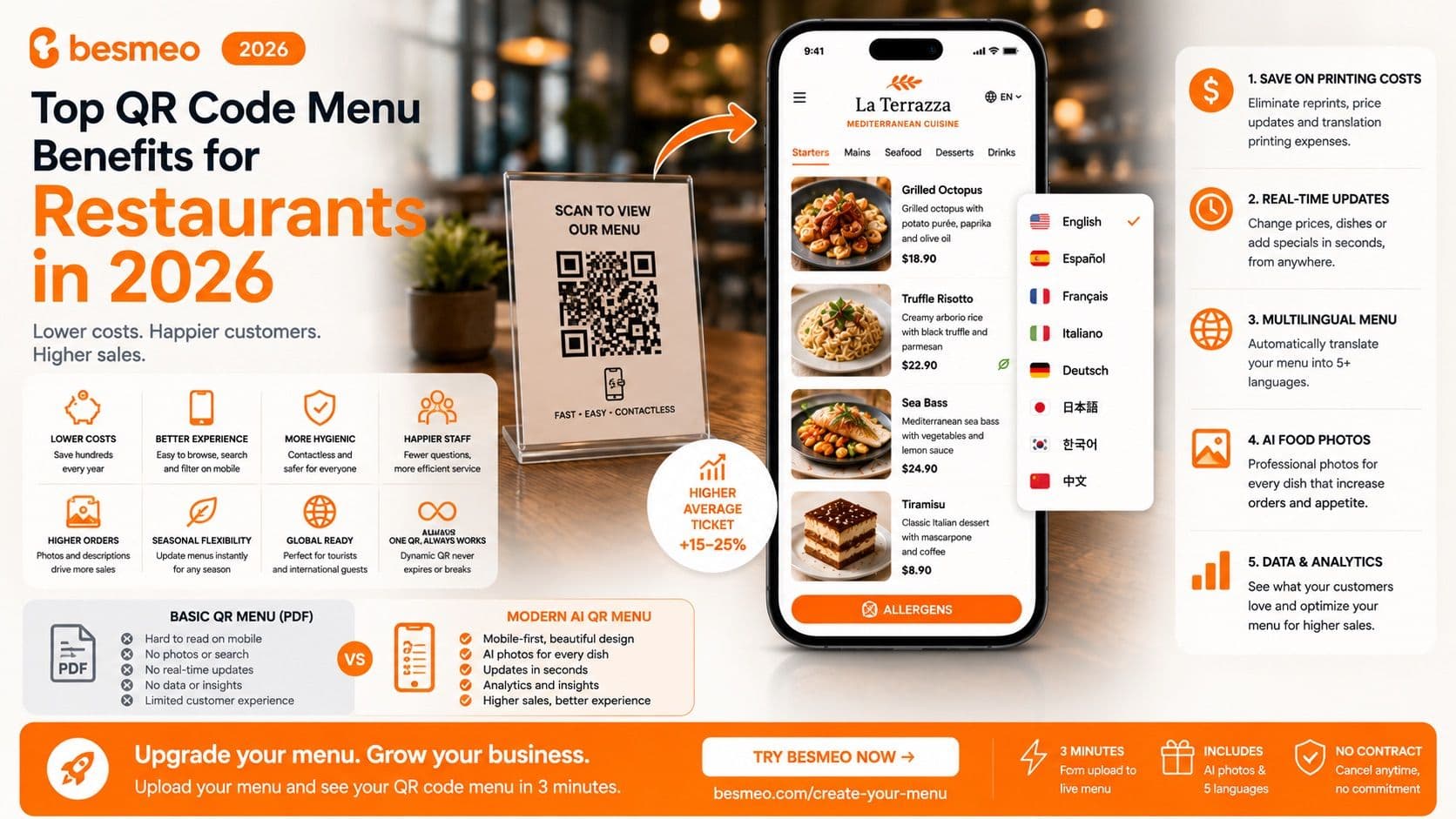
Meta description: Discover the top QR code menu benefits for restaurants — from saving on printing costs to AI food photos, multilingual support, and instant menu updates.
Top QR Code Menu Benefits for Restaurants in 2026
Five years ago, QR code menus felt like a pandemic workaround. Restaurants slapped them on tables because they had to, and customers tolerated them because they had no choice. Most people assumed they'd disappear the moment things went back to normal.
That's not what happened. In 2026, QR code menus aren't just still here — they've evolved into something completely different from those early pandemic PDFs. The restaurants that have adopted modern QR menus are seeing measurable returns: lower operating costs, higher average tickets, better customer experience, and operational flexibility their competitors don't have.
This article walks through the real benefits — not the marketing pitches, but the actual financial and operational advantages restaurants are reporting in 2026. We'll also separate the basic QR-to-PDF setup most restaurants are still stuck with from the modern AI-powered digital menus that are quietly redefining the category.
How QR menus went from pandemic stopgap to permanent fixture
According to multiple industry surveys, over 60% of US restaurants now use some form of QR code menu, up from less than 10% before 2020. More tellingly, 88% of restaurants that adopted QR menus during the pandemic kept them afterward.
Why? Because once restaurant owners actually used them for a few months, they realized something. The PDF version was inferior to a paper menu in almost every way. But a properly built digital menu was better than paper across the board — faster to update, cheaper to maintain, and far more useful for both staff and customers.
The QR code itself was never the point. It's just the bridge between the physical table and a digital experience. The real value is what lives on the other side of that scan.
1. Massive reduction in printing costs
This is the easiest benefit to measure. A typical mid-sized restaurant spends $400–$1,500 per year on menu printing — between regular reprints when prices change, seasonal updates, replacements for damaged menus, and translated versions for tourist areas.
With a QR code menu, these costs effectively go to zero. You print the QR code once. The menu it links to can change a hundred times without reprinting anything.
The savings are even larger for restaurants that update their menu frequently — seasonal kitchens, tasting menus, chef's specials, daily soups. What used to require either printing inserts or accepting that the printed menu was always slightly outdated now happens with a single tap on a phone.
2. Real-time updates from anywhere
This is the operational benefit that most surprises restaurant owners after they switch. With a paper menu, every change is a project. A new dish requires a redesign. A price change requires a reprint. Selling out of an item requires telling every server and hoping nobody forgets to mention it.
With a modern digital menu, all of that goes away. You change a price from your phone in 10 seconds. You hide a sold-out item with one tap and unhide it the next morning. You add a Friday night special at 4 PM and remove it Sunday morning.
The implications go beyond convenience. Restaurants that update prices in real time don't lose margin during supplier cost spikes. Restaurants that mark items unavailable instantly stop wasting server time on apologies. Restaurants that test seasonal items can pull them quickly if they don't sell.
This level of operational agility used to be impossible for restaurants without expensive POS integrations. A QR code menu democratizes it.
3. Hygiene improvements customers still appreciate
The hygiene argument felt urgent during the pandemic. It feels less urgent now, but it hasn't gone away — particularly for international tourists and customers who travel for business.
A laminated paper menu gets touched by hundreds of customers per week. It sits between sticky hands, gets wiped with the same cloth that wipes the table, and accumulates a layer of dirt that no amount of cleaning fully removes. Most customers don't consciously think about this, but they notice when a restaurant feels clean and they notice when it doesn't.
A QR menu eliminates the shared physical object. Each customer interacts with their own phone, in their own way. The hygiene benefit is real, even if nobody talks about it as much as they did in 2020.
4. Better mobile experience (when done right)
A laminated menu was designed for a physical interaction — read top to bottom, scan with your eyes, point at what you want. A QR code menu opened up the possibility of designing for the actual device customers were using: their phone.
When implemented properly, this leads to a measurably better customer experience. Tappable category filters let customers jump straight to the section they want. Search bars let them find specific dishes. Photos appear inline at the right size, not as tiny print thumbnails. Dishes can be expanded to show full descriptions and allergen information without clutter.
The data backs this up: customers spend longer browsing well-designed digital menus than they do paper menus, and they order more items per visit. The increased engagement translates directly to higher average tickets.
The catch: this only works if the digital menu is actually designed for mobile. A QR code linking to a PDF doesn't deliver any of these benefits — it just makes the bad menu harder to read on a phone screen.
5. Photos that drive ordering decisions
Multiple studies have shown that menu items with photos sell roughly 6.5% more than the same items without. For restaurants with high-margin signature dishes, this number adds up fast.
Paper menus could technically include photos, but most don't, because the cost of getting professional photography for every dish is prohibitive — $300–$800 per session, and the menu becomes outdated the moment you add new items.
Modern digital menus solve this by integrating AI food photography directly into the menu workflow. Platforms like Besmeo automatically generate a professional-looking photo for every dish when you upload your menu, without needing to hire a photographer or even take any photos yourself. The result: a fully visualized menu in 3 minutes instead of three weeks.
For restaurants in tourist areas, photos do something else important: they communicate what each dish actually is to customers who can't read the description. A German tourist who can't decipher "lubina a la espalda" can absolutely understand a photo of a beautifully plated sea bass. Photos convert ambiguity into confidence, and confidence into orders.
6. Multilingual menus that don't require translators
For any restaurant that serves international customers, language is one of the biggest revenue leaks in the operation. A tourist who can't fully understand your menu defaults to whatever they recognize — chicken, beer, salad — instead of the higher-margin dishes you actually want to sell.
A printed bilingual menu is expensive (two versions to maintain, two sets of reprints) and impractical beyond two or three languages. Five-language printed menus essentially don't exist outside of major chains.
A modern QR code menu solves this completely. Customers scan the same QR code regardless of language. The menu detects their phone's language and shows the version that matches. A French tourist sees the menu in French. A Japanese tourist sees it in Japanese. The restaurant maintains one menu, not five.
For tourist-area restaurants, this is one of the highest-impact upgrades possible. A multilingual menu doesn't just improve the customer experience — it directly raises average ticket sizes by letting customers order what they actually want, not just what they recognize.
7. Built-in customer data and analytics
Paper menus are silent. You print them, customers read them, and you never know what they did. Did they look at the seafood section? Did they consider the new pasta dish? Did they decide based on price or description?
Digital menus give you all of this data. Modern platforms show you which dishes get viewed most often, how long customers spend on different sections, which items get clicked on without being ordered, and which languages your customers actually use.
This information is gold for menu optimization. If your high-margin signature dish is barely viewed, the placement is wrong. If a low-margin appetizer gets viewed more than your mains, you have a positioning problem. If 30% of your customers switch to French, you know exactly where your traffic is coming from.
Restaurants that use this data quarterly to refine their menu consistently outperform those that set the menu once and forget about it.
8. Permanent QR codes that survive any menu change
One detail most restaurant owners miss until they get burned by it: not all QR codes are the same.
A static QR code points to a fixed URL forever. If you ever switch tools, restructure your URL, or change platforms, every QR code you've printed becomes useless. A dynamic QR code points to a managed URL that you can update from a dashboard. The QR code itself never changes — only the menu it points to.
Modern QR menu platforms use dynamic QR codes by default. You print the code once, and it stays valid forever, regardless of how many times you redesign the menu, change tools, or evolve your restaurant.
This sounds like a minor detail, but it represents a permanent cost saving and a real operational benefit. A restaurant that changes tools every few years would otherwise be reprinting QR codes every time.
9. Faster service and lower server workload
A digital menu shifts the information flow from server to customer. Instead of waiting for a server to recite the daily specials, customers see them on their phone. Instead of asking "is this gluten-free?", they tap the allergen filter. Instead of asking "what's in the pasta?", they read the description with photos.
This frees up servers to do the work that actually matters: greeting customers, taking orders, handling problems, and creating the relational experience that brings customers back. The mundane informational queries get handled by the menu itself.
For high-volume restaurants, this efficiency translates to higher table turnover and lower labor stress. For lower-volume restaurants, it lets the same staff deliver better service to each table.
The gap between basic and modern QR menus
After reading all of the above, it should be clear that a QR code linking to a PDF delivers almost none of these benefits. The QR code is just a redirect — the value lives in what the QR points to.
Most restaurants still using QR codes are stuck with the basic version: a code that opens a PDF or a poorly designed mobile page. They get the hygiene benefit and avoid some printing costs, but they miss the bigger gains in revenue, customer experience, and operational flexibility.
Modern AI-powered QR menus close this gap. They generate professional dish photos automatically, translate to multiple languages, allow instant updates from a phone, and track which dishes are working. They cost more than a free QR code generator — typically around $49/month — but the return on investment is measurable within weeks for any restaurant serious about its menu.
Making the switch
If you're still running a PDF menu behind a QR code, the upgrade path is simpler than you might expect. You don't need to manually rebuild your menu — modern platforms accept your existing PDF and convert it automatically. You upload your current menu, the system extracts every dish and price, generates photos, and produces a finished mobile menu in about 3 minutes.
The cost of staying on a basic PDF setup adds up: the lost revenue from tourists who can't read the menu, the printing costs you still pay for reprints, the orders that don't happen because customers can't see what dishes look like, the staff time spent answering questions that a proper menu would answer automatically.
A QR code menu in 2026 isn't a pandemic relic. It's one of the highest-leverage operational upgrades available to any restaurant — provided you go beyond the basic version and use it for what it can actually do.
[CTA: Upload your menu and see your QR code menu in 3 minutes →