Allergens on the Restaurant Menu: What Is Mandatory and How to Keep Them Constantly Updated
Allergens on the Restaurant Menu: What Is Mandatory and How to Keep Them Constantly Updated
Yes, restaurants in Spain are legally required to inform customers about the presence of any of the 14 mandatory food allergens across all dishes, pursuant to EU Regulation 1169/2011 and Royal Decree 126/2015. While printing them on the main menu is not compulsory, the information must be clear, accessible, and verifiable before ordering.
Running an independent bar or restaurant in Spain means living on your feet. Between checking supplier delivery notes, balancing shift rosters, keeping the kitchen running smoothly during peak hours, and looking after the front of house, a standard shift easily clocks 12 to 14 hours. The last thing you need is digging through legal gazettes dense with bureaucratic jargon just to ensure you will not fail your next municipal health inspection.
In most independent Spanish venues, allergens on the restaurant menu were resolved years ago using a standard stopgap: someone typed an Excel grid, printed it out, slipped it into plastic sleeves, and tucked the folder under the bar counter or next to the POS terminal. The problem is rarely the folder itself; it is what happened since. Three suppliers have changed, your head chef switched the thickener in two signature sauces, and four seasonal dishes joined the menu. That printed folder no longer reflects what is actually on the plate—and that gap creates a direct risk for both your diners and your business.
This guide details what Spanish hospitality regulations strictly require, where troublesome ingredients tend to hide in daily kitchen prep, and how to keep your allergen details up to date without wasting time or reprinting paper menus after every minor ingredient change.
Informative Note: This article is provided solely for general practical and educational purposes for food service operators. It does not constitute legal counsel and does not supersede official health regulations or directives issued by AESAN or your local regional health department.
What Does Spanish and European Allergen Legislation Actually Require from Restaurants?
Food allergen regulations governing hospitality in Spain stem from two core frameworks: Regulation (EU) No 1169/2011 on the provision of food information to consumers, and Spain’s national transposition, Real Decreto 126/2015, which applies the European rule to non-prepacked foods. This covers every item prepared and sold across bars, restaurants, cafeterias, catering services, and takeaway kitchens.
Stripped of legal jargon, the legislation sets out four practical mandates:
- Mandatory identification of the 14 EU allergens: You must know and disclose whether any of the 14 regulated allergens are present in your dishes, tapas, sides, desserts, or drinks—whether introduced as a primary ingredient, a component of a processed sauce, an additive, or a processing aid.
- Availability prior to purchase: The customer has the legal right to access this information before ordering or paying for their meal. Disclosing allergens after food arrives at the table violates compliance standards.
- Free and accessible delivery: Allergen details must be provided at no extra charge, and the premises must display a visible, easily spotted sign (or a note on the menu) explaining how diners can consult or request the allergen specifications.
- Internal traceability: Should a health inspector examine your kitchen, you must be able to substantiate your allergen declarations. This requires retaining the original packaging labels or supplier technical data sheets (fichas técnicas) for commercial supplies, along with standardized ingredient lists for in-house preparations.
The law does not restrict your kitchen from cooking with wheat flour, prawns, cream, or tree nuts. It requires uncompromising transparency: whenever an item contains sesame, celery, or sulphites, an allergic or intolerant guest must be able to identify it immediately and avoid ordering it.
What Are the 14 Mandatory Allergens, and Where Do They Hide in Your Kitchen?
Recognizing the 14 mandatory allergens is straightforward when dealing with single raw ingredients—everyone knows a king prawn is a crustacean and parmesan is a dairy product. The critical hazard in a commercial kitchen lies in compound bases, commercial stocks, blended sauces, processed meats, and seasoning mixtures where fine-print ingredients frequently escape notice during a busy lunch service.
Below is the complete official register of the 14 declarable allergens and the everyday culinary preparations where they commonly hide:
- Cereals containing gluten (wheat, rye, barley, oats, spelt, kamut, or their hybridized strains) and products thereof: Beyond plain bread, pasta, and breadcrumbs, gluten frequently hides inside flour-thickened sauces (roux), industrial bouillon cubes, processed charcuterie (such as chorizo or black pudding using starch as a binder), dessert biscuit crusts, malt vinegar, and standard commercial soy sauces.
- Crustaceans and products thereof (prawns, langoustines, crayfish, crabs, lobsters): Rarely missed as whole seafood, but often overlooked when concentrated prawn heads enrich a seafood broth, inside blended seafood rice bases, in kimchi, or within Southeast Asian curry pastes that rely on fermented shrimp paste.
- Eggs and products thereof: Outside omelettes and house-made mayonnaises, eggs lurk within fresh egg pasta, commercial batter mixes, pastries or empanadas glazed with beaten egg wash for a golden sheen, wines fined with egg albumin, and lysozyme (a preservative derived from egg white common in aged cheeses).
- Fish and products thereof: Consistently masked inside traditional Caesar salad dressings (which require an anchovy base), Worcestershire sauce (salsa Perrins, brewed with fermented anchovies), fish-based gelatin, commercial surimi sticks, and vegetable paella broths that share an unwashed ladle with a seafood stockpot.
- Peanuts and products thereof: Beyond traditional bar snacks, peanuts frequently hide within blended vegetable frying oils, commercial pesto varieties that swap pine nuts for cheaper peanut fillers, satay dips, mole sauces, and pre-made bakery treats or ice creams sourced from external vendors.
- Soybeans and products thereof: One of the most ubiquitous industrial ingredients. Found not only in soy sauce, edamame, and tofu, but also as soy lecithin (E-322) in pastry chocolate coatings, commercial burger buns, catering margarines, dairy desserts, and pre-formed minced meat patties or meatballs.
- Milk and products thereof (including lactose): Cross-contamination and formulation surprises frequently occur when finishing risottos or glossy sauces with a cold pat of butter, inside potato purées, within boiled sausages and deli meats (such as cooked ham or mortadella using milk protein or lactose as water binders), in croquettes, and inside sliced sandwich bread.
- Nuts (almonds, hazelnuts, walnuts, cashews, pecans, Brazil nuts, pistachios, and macadamia nuts): In traditional Spanish cuisine, a picada or fried nut paste (typically toasted almonds or hazelnuts) is routinely blended to thicken meat stews, meatballs in sauce, fish casseroles (suquets), and classic romesco sauce. A patron ordering a beef stew rarely suspects ground almonds are integrated into the gravy unless explicitly flagged.
- Celery and products thereof: The primary hidden allergen across the hot line and cold prep. Nearly every classic chicken, beef, or vegetable stock starts with a mirepoix containing celery ribs. It is equally common in seasoned meat rubs, commercial dehydrated bouillons, and blended vegetable soups.
- Mustard and products thereof: Evident in burger condiments, yet constantly overlooked when whisked into house salad vinaigrettes, barbecue glazes, ribs marinades, steak tartare, and pickling brines for gherkins and cocktail onions.
- Sesame seeds and products thereof: Readily spotted on burger buns, but concealed within Spanish breadsticks (picos and regañás), hummus (via sesame tahini), sesame finishing oil used in wok stir-fries or seared tuna tataki, and seeded sandwich loaves.
- Sulphur dioxide and sulphites (at concentrations above 10 mg/kg or 10 mg/litre): When deglazing pans or simmering stews with white wine, red wine, brandy, or sherry vinegar, sulphites remain in the dish even after the alcohol boils off. They also act as an antioxidant preventing black spots on raw or cooked prawns, in vacuum-packed peeled catering potatoes, in dried fruits (such as raisins or apricots), and in fresh sausage mince.
- Lupin and products thereof: Outside whole pickled lupin beans served as traditional tavern snacks (altramuces), lupin flour is increasingly incorporated by industrial bakeries to improve dough elasticity, color, and texture in burger buns, pre-baked pizza crusts, pastries, and gluten-free specialty goods.
- Molluscs and products thereof (mussels, clams, cockles, oysters, squid, cuttlefish, octopus, snails): Often integrated covertly through commercial oyster sauce used in stir-fries, cuttlefish or squid ink used to tint black rice (arroz negro) and fresh pasta, and blended seafood stock bases.
Does the Allergen Information Have to Be in Writing, or Can Waiting Staff Just Explain It?
This remains a point of confusion across dining rooms. Spain's Royal Decree 126/2015 allows food service businesses to convey allergen information verbally, but it imposes stringent conditions before verbal communication is accepted as legally valid.
First, even if floor staff advise customers at the table verbally, your premises must exhibit visible signage prominently stating that allergen information can be requested from the staff. Second—and this is where many venues fall short during inspections—that verbal exchange must be anchored by a verifiable written or electronic master record maintained on-site, immediately accessible to floor staff, kitchen teams, visiting health officers, and diners upon request.
In short: allowing waiting staff to recite ingredients at the table does not exempt your establishment from keeping an updated written or digital register.
Relying exclusively on staff memory during a hectic Friday night rush is an operational liability:
- Staff turnover and casual hires: Hospitality relies heavily on weekend extras and temporary staff who cannot realistically master the exact formulations of every multi-ingredient stock, marinade, and dressing.
- Last-minute kitchen substitutions: If the kitchen runs short of sunflower oil and fries chips in a vat previously used for breaded squid, or if a supplier substitutes cooking cream with a variant containing an unexpected stabilizer, floor staff rarely hear about it before taking orders.
- Terminology confusion: A momentary verbal mix-up during service (confusing gluten intolerance with dairy allergies, or failing to recall that a dressing incorporates anchovy-based Worcestershire sauce) can trigger a life-threatening anaphylactic event and serious liability.
Because health enforcement is administered regionally across Spain’s autonomous communities and municipal districts, practical verification requirements vary. Always check guidance released by the Spanish Agency for Food Safety and Nutrition (AESAN) and confirm local enforcement criteria directly with the competent health authority of your autonomous community or city council. Keeping unambiguous allergen specifications available in print or via an accessible digital display remains the safest operational choice.
How Should Allergens Be Displayed on a Restaurant Menu?
To eliminate verbal guesswork at the table, you need an established method for showing how to put allergens on the menu. Spanish establishments generally rely on three approaches, each presenting practical operational trade-offs.
1. Allergen Icons Beside Every Item on the Printed Menu
This method places graphic symbols (such as a wheat stalk for gluten, a milk bottle for dairy, or a shrimp for crustaceans) directly alongside each dish name and price on your printed cards.
- Pros:
- Customers view dietary markers immediately without waiting to ask staff for secondary documents.
- Demonstrates upfront transparency and kitchen competence.
- Cons:
- Zero flexibility when recipes change: If a distributor runs out of your regular croquettes and delivers a replacement brand containing traces of soy or celery, your entire printed menu inventory becomes instantly inaccurate. You are forced to apply messy correction stickers, draw over cards by hand, or fund a full reprint run.
- Visual clutter: Traditional dishes with layered sauces that feature five or six allergens result in a cluster of tiny symbols that crowds the layout and impairs readability.
- No universal graphic standard: Because the European Union never standardized an official set of icons, confusing illustrations often leave guests uncertain whether a drawing depicts peanuts, tree nuts, or lupin unless a bulky legend consumes part of the page.
2. A Dedicated Allergen Folder or Matrix Binder
A standalone two-dimensional table—dishes listed on the rows, the 14 allergens along the columns, with checkmarks indicating presence—stored behind the bar or at the POS workstation.
- Pros:
- Preserves clean aesthetics across your main dining menu.
- Can be assembled and printed relatively inexpensively on standard office paper.
- Cons:
- The "forgotten binder" syndrome: This format generates regular inspection warnings because teams routinely forget to reprint it. The primary menu updates with new seasonal specials, but the binder remains fixed in the state it was printed two years prior.
- Friction for allergic patrons: Guests managing severe allergies often hesitate to disrupt staff during peak rushes to ask for an archived document, or end up waiting awkwardly while the team searches for where the binder was misplaced.
- Reading errors: Tracking a finger across 60 rows and 14 narrow columns under dim dining room lighting invites misalignment, causing diners to misread critical rows.
3. An Interactive Digital Menu with Allergen Filters
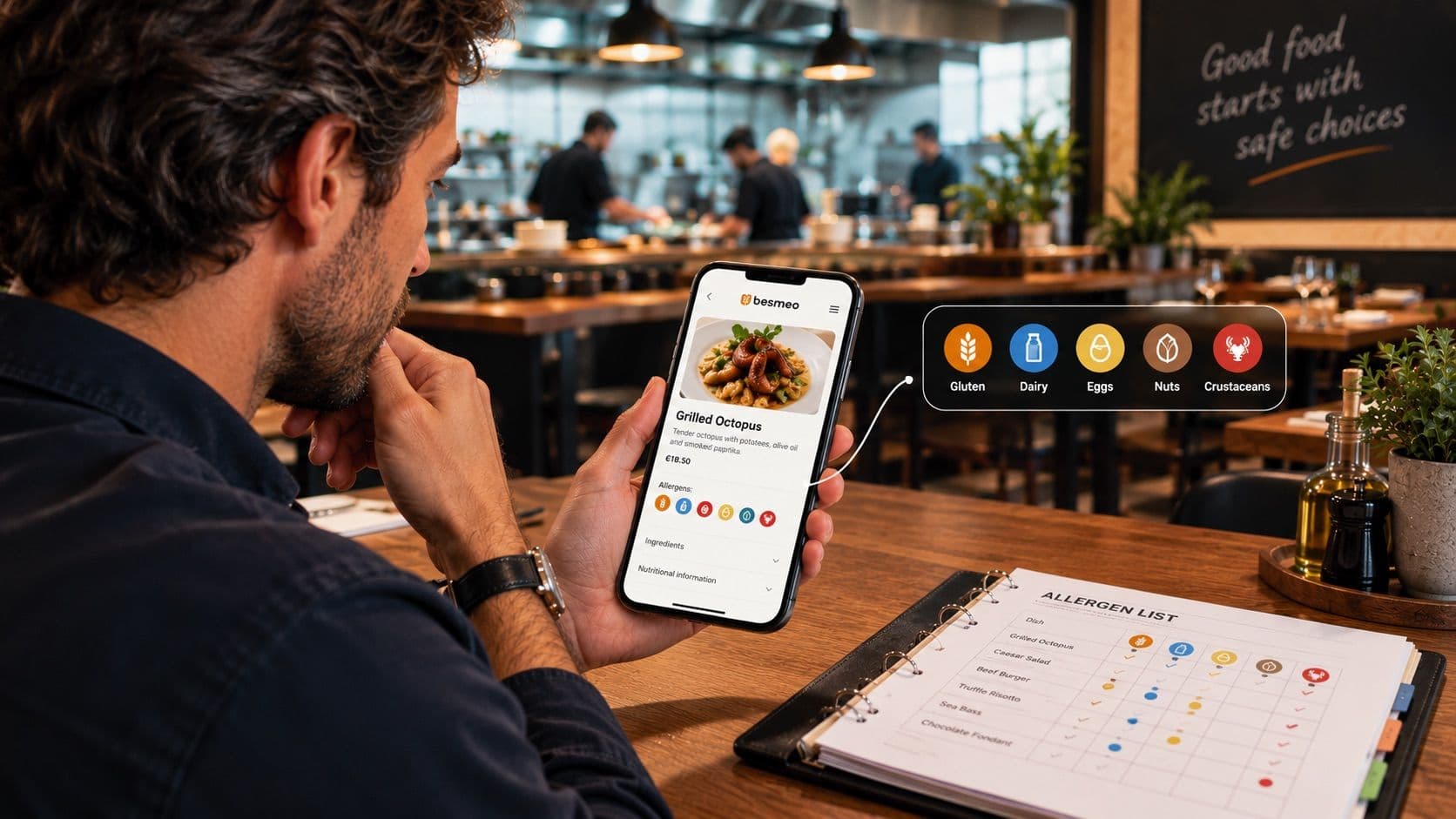
Diners scan a tabletop QR code using their mobile phone (or consult an in-house tablet) to load a dynamic menu where items display their certified allergens, complete with interactive filtering. If your venue still displays static downloads, learn how to [ENLACE: convertir carta PDF en carta digital] to migrate to an easily managed format.
- Pros:
- Real-time updates: If an ingredient changes during prep at 13:15, open the management screen on your mobile phone at 13:16, toggle the new allergen badge, and save. Every table scanning the QR code sees the revised information immediately.
- Personalized filtering: A diner with dual allergies to eggs and shellfish can select those exclusions on their screen to view only items safe for their diet, streamlining the ordering cycle and freeing waiting staff from repetitive queries.
- Unambiguous labels: Interactive menu allergen icons reveal their full text descriptions when tapped, eliminating confusion over unclear symbols.
- Multi-language synchronization: Editing an allergen on a dish updates all active language translations across your system simultaneously.
- Cons:
- You must keep an updated printout or an in-house tablet ready for elderly diners or visitors whose phones have run out of battery.
| Format | Update Speed | Cost per Recipe Modification | Allergic Diner Experience | Risk of Becoming Outdated | | :--- | :--- | :--- | :--- | :--- | | Icons on Printed Paper | Very slow (requires reprinting) | High (graphic work + print run) | Decent if a clear legend is included | High (updates deferred to avoid costs) | | Separate Matrix / Excel Binder | Moderate (manual edit + print) | Low (office paper and toner) | Poor (requires asking staff; hard to align rows) | Very high (routinely abandoned) | | Digital Menu with Filters | Instant (via mobile in seconds) | Zero | Excellent (independent, clear, filterable) | Very low (updated immediately on the fly) |
Ready to digitize your restaurant?
Create my menuWhat Are the Most Common Allergen Mistakes Made by Restaurants?
Independent restaurateurs do not set out to mislead patrons or trigger allergic reactions. However, the sheer pace of commercial food service frequently leads to four predictable compliance oversights:
1. Operating with Outdated Allergen Records After Recipe or Supplier Switches
This remains the most prevalent compliance failure in Spain. Consider a kitchen that prepares house patatas bravas using a scratch sauce thickened safely with cornstarch. One afternoon, the regular paprika runs out, or the kitchen introduces a commercial prepared brava base to handle weekend volume. That commercial base contains wheat flour thickeners. The cook knows the change was made, but nobody updates the printed binder or the menu icons. A regular guest with coeliac disease orders their usual dish, relies on previous safety, and suffers acute contamination. Whenever a new packaging brand crosses the kitchen threshold, someone must inspect the label and mirror those findings on the menu.
2. Failing to Address Cross-Contamination and Trace Allergens
The fact that your hand-cut chips contain only potatoes, olive oil, and salt does not automatically make them allergen-free. If those potatoes are dropped into a deep fryer that previously fried battered squid rings (molluscs, gluten, egg) or croquettes (gluten, milk), the hot oil transfers microscopic allergen proteins directly onto the fries. For a guest with an acute allergy or coeliac disease, cross-contact poses the exact same biological hazard as consuming the ingredient deliberately. The same principle applies to shared griddles, deli meat slicers, shared chopping boards, and plating spoons. If your line cannot isolate equipment, you must disclose the operational risk of trace cross-contamination.
3. Displaying Cryptic Allergen Icons Without an Explanatory Legend
As noted earlier, a wide range of graphic sets are used across Spain. On many menus, lupin icons resemble a dish of generic mixed nuts; soybeans look identical to garden sweet peas (which are not declarable allergens); and sulphites are marked with ambiguous labels like $SO_2$ or chemical flasks. Displaying unexplained graphic badges without an adjoining plain-text glossary matching the customer's language fails compliance standards and leaves diners guessing.
4. Overlooking Foreign-Language Menus and Blackboard Specials
Many venues in high-traffic destinations keep their Spanish menu updated but neglect their English, French, or German variants, leaving stale PDFs online or obsolete cards on display. Similarly, off-menu chef's specials (fueras de carta) chalked onto blackboards or recited tableside must comply with the exact same allergen traceability standards applied to the permanent menu.
Why Must Foreign-Language Allergen Information Be Human-Verified Rather Than Left to Machine Translation?
Spain welcomes tens of millions of international travellers annually. For a visitor managing a severe food allergy, dining abroad in an unfamiliar language is intensely stressful. Conversely, venues that deliver accurate, native-language allergen notices quickly win lasting trust and word-of-mouth recommendations from international travellers.
Trouble arises when restaurants attempt to cut corners by running their menus through automated, generic translation tools without culinary review. A funny translation of a dish name might draw a smile, but an automated translation error involving food allergens poses an immediate medical hazard.
Spanish culinary phrasing frequently uses terms that generic algorithms misinterpret or fail to parse, hiding dangerous allergens from international diners:
- "Frutos secos" versus "Dried fruits": In everyday Spanish, frutos secos denotes tree nuts like almonds, walnuts, and hazelnuts. Automated engines frequently translate this literally into English as dried fruits (such as raisins, dates, or prunes). A British diner allergic to tree nuts who reads dried fruits will assume the plate contains harmless raisins, order the dish, and risk acute anaphylaxis.
- Traditional preparations that disguise key ingredients: Terms such as picada, majado, alioli, romesco, rebozado a la andaluza, or txangurro communicate little to a visiting German or French guest unless paired with standard, regulated EU allergen classifications in their native language.
Whenever you prepare to [ENLACE: traducir la carta del restaurante], make sure your allergen listings employ the official standardized EU terminology for each language (Celery, Mustard, Tree nuts, Crustaceans, Molluscs, etc.), verified by someone who understands culinary terminology. Setting up an interactive digital platform that comes pre-configured with compliant multilingual allergen classifications removes the risk of a raw machine translation swapping a walnut for a raisin.
Why Is a Digital Menu Easier to Keep Accurate Than Paper or PDF Files?
Every experienced restaurateur knows why printed sheets and static PDFs become outdated: correcting them is slow, tedious, and disrupts kitchen routines.
Whenever an ingredient changes on a paper menu or a PDF, the path to compliance is frustrating: you must contact your designer or open a computer late at night, retrieve the source file, rearrange the graphic badges without breaking the page grid, export the file, upload it to the server or send it to the print shop, wait for the delivery, pay the invoice, and swap out the physical menus across your tables. Because this cycle is cumbersome and expensive, updates are postponed, leaving your business exposed.
A purpose-built digital menu eliminates that friction by separating raw culinary data from presentation, placing menu management directly onto your smartphone:
- Updates completed in seconds from the kitchen: As a morning delivery arrives, you notice the replacement brand of cooking sausages carries warnings for mustard and soy. You pull your phone from your pocket, locate the dish in your menu manager, tap "Soy" and "Mustard," and hit save. The correction goes live across every table QR code before the lunch shift starts.
- Instant synchronization across all languages: If you manage print menus in Spanish, English, French, and German, updating an allergen requires manual edits across four separate files. In an interactive digital system, allergens attach directly to the dish record: update the item once on your screen, and every enabled language updates automatically with its verified regulatory equivalent.
- Operational agility during daily prep: Just as a digital system allows you to [ENLACE: cambiar precios sin reimprimir] when wholesale oil or seafood costs fluctuate, or hide a sold-out special with a single tap, it enables you to adapt food safety notices dynamically with zero print costs.
The Allergen Audit Checklist for Every Menu Change
To ensure no detail escapes your team when updating dishes, launching seasonal offerings, or onboarding new suppliers, keep this checklist on hand for your head chef and floor manager:
- [ ] Audit supplier specifications and packaging labels: Have we inspected ingredient declarations on all newly introduced commercial bases, broths, processed meats, bakery goods, and pre-packaged desserts?
- [ ] Break down compound recipes (stocks and base sauces): Have we catalogued hidden ingredients across basic stocks (celery in meat broths, prawn heads in fish fumets, sulphites in wine reductions, ground nuts in thickening pastes)?
- [ ] Inspect sides, toppings, and garnishes: Have we reviewed secondary dish elements (seasoned fries containing wheat dustings, breadsticks with sesame, micro-seed garnishes, mustard dressings, or butter glazed over vegetables)?
- [ ] Evaluate kitchen cross-contact risks: Which fryers, griddles, and cutting stations will prepare this item? If equipment is shared with gluten, fish, eggs, or shellfish, is the trace contamination warning clearly stated?
- [ ] Check daily blackboards and off-menu specials: Are daily specials and temporary offerings documented with the same allergen rigor as the main menu?
- [ ] Review drinks and dessert pairings: Have we audited dessert recipes and confirmed sulphite warnings across wines, ciders, gluten levels in craft beers, or nut liqueurs?
- [ ] Verify across all foreign-language menus: If foreign languages are active for tourists, have the updated allergen tags carried across accurately to those translations?
- [ ] Purge obsolete documentation: Have outdated paper cards, discarded printouts, or superseded binder sheets been removed from service stations to prevent conflicting information?
- [ ] Brief the floor team: Are waiting staff on duty informed of today's recipe updates and clear on how to point diners to the verified digital record?
Keep Your Restaurant's Allergens Compliant Without the Headache Using Besmeo
Your focus belongs on cooking exceptional food and managing a thriving service, not spending your rare rest hours wrestling with Excel formulas or desktop design suites. If you want to see [ENLACE: cómo crear una carta digital] that removes the anxiety of outdated paper records, Besmeo was built around the daily realities of independent restaurants and bars in Spain.
Besmeo turns your current menu into a dynamic, mobile-friendly digital experience ready for your tables in minutes:
- One-tap allergen assignment: Link any of the 14 mandatory allergens to a dish with a single tap on your screen. Diners see clear, understandable icons with text descriptors and can filter the menu to view only the dishes that match their dietary restrictions.
- Instant mobile administration: When a supplier substitutes an ingredient or prep changes on the line, open your phone, adjust the dish parameters, and publish the update live to your table QR codes immediately.
- Automatic translation across 5 languages: Your dishes and allergen warnings appear translated into 5 languages, giving visiting tourists absolute clarity without dining room confusion.
- Clear division of operational responsibility: Technology supports clear communication, but kitchen vigilance remains essential; accurate identification of recipes, ingredients, and cross-contact risks remains the restaurant's operational duty. Besmeo gives you the most responsive platform to communicate that data accurately without printing costs.
You can access Besmeo for [PRECIO BESMEO], without long-term lock-in contracts or hidden charges. To see how effortlessly it works on your line, take advantage of the 14-day free trial with no credit card required.
👉 Create your free digital menu on Besmeo here
Frequently Asked Questions About Restaurant Menu Allergens (FAQ)
1. Are restaurants in Spain required to use a specific, standardized set of allergen icons?
No. Neither EU Regulation 1169/2011 nor Spain's Royal Decree 126/2015 establishes an official mandatory icon set. You are free to pick any visual style that complements your branding, provided the symbols are clear, unambiguous, and supported by a legible legend or direct text labels so guests do not have to guess what each graphic means.
2. Must I declare allergens on daily lunch specials and complimentary tapas?
Yes, without exception. The law covers all non-prepacked food served to consumers across hospitality operations. This covers your primary menu, fixed-price lunch specials (menú del día), chef's suggestions, combo platters, bar tapas, and even the complimentary snack offered alongside a beer or glass of wine.
3. What is the difference between an ingredient that "contains" an allergen and one with "traces"?
A dish contains an allergen when it is a deliberate, direct ingredient in the preparation (such as wheat flour in a croquette or egg in an omelette). In contrast, traces or cross-contact refer to situations where an allergen is not part of the recipe, but minute particles might enter the dish inadvertently via shared supplier processing facilities or shared kitchen equipment (such as using the same fryer or grill without an allergen decontamination protocol). For an individual with an acute allergy, both scenarios present severe health risks and must be communicated.
4. Is allergen declaration required for beverages listed on the menu?
Yes, whenever they contain any of the 14 regulated allergens. Common examples across Spanish bars include sulphites in wines, cavas, ciders, and vermouths, gluten-containing cereals (barley, wheat) in beers, and milk, egg, or nuts utilized in dessert liqueurs, blended milkshakes, or specialty cocktails.
5. What is the difference between a cow's milk allergy and lactose intolerance when marking menus?
Lactose is a milk sugar, whereas milk allergies are triggered by milk proteins such as casein or whey. The EU category covers "Milk and products thereof (including lactose)". If your kitchen utilizes "lactose-free" dairy cream or milk to assemble a sauce or dessert, the item is safe for someone with lactose intolerance, but still contains cow's milk proteins. You must continue to flag the "Milk" allergen to protect diners with true dairy allergies.
6. Does a QR digital menu completely replace the requirement to inform patrons without smartphones?
A digital menu provides an outstanding, compliant method for displaying allergen data to the overwhelming majority of modern guests. However, because regulations mandate that food information must be readily accessible to all patrons, venues should keep an updated print version or an on-site tablet