Your PDF Menu Is Costing You Money. Here's What to Do Instead.
Your PDF Menu Is Costing You Money. Here's What to Do Instead.
You spent money on a QR code. You printed little table tents. You uploaded your menu as a PDF. You checked the "digital menu" box.
Except your customers are still squinting at their phones, pinching to zoom, and giving up after three seconds. That's not a digital menu. That's a paper menu with extra steps.
And it's quietly bleeding you money every single service.
The PDF problem nobody talks about
Here's what happens when a customer scans your QR code and gets a PDF:
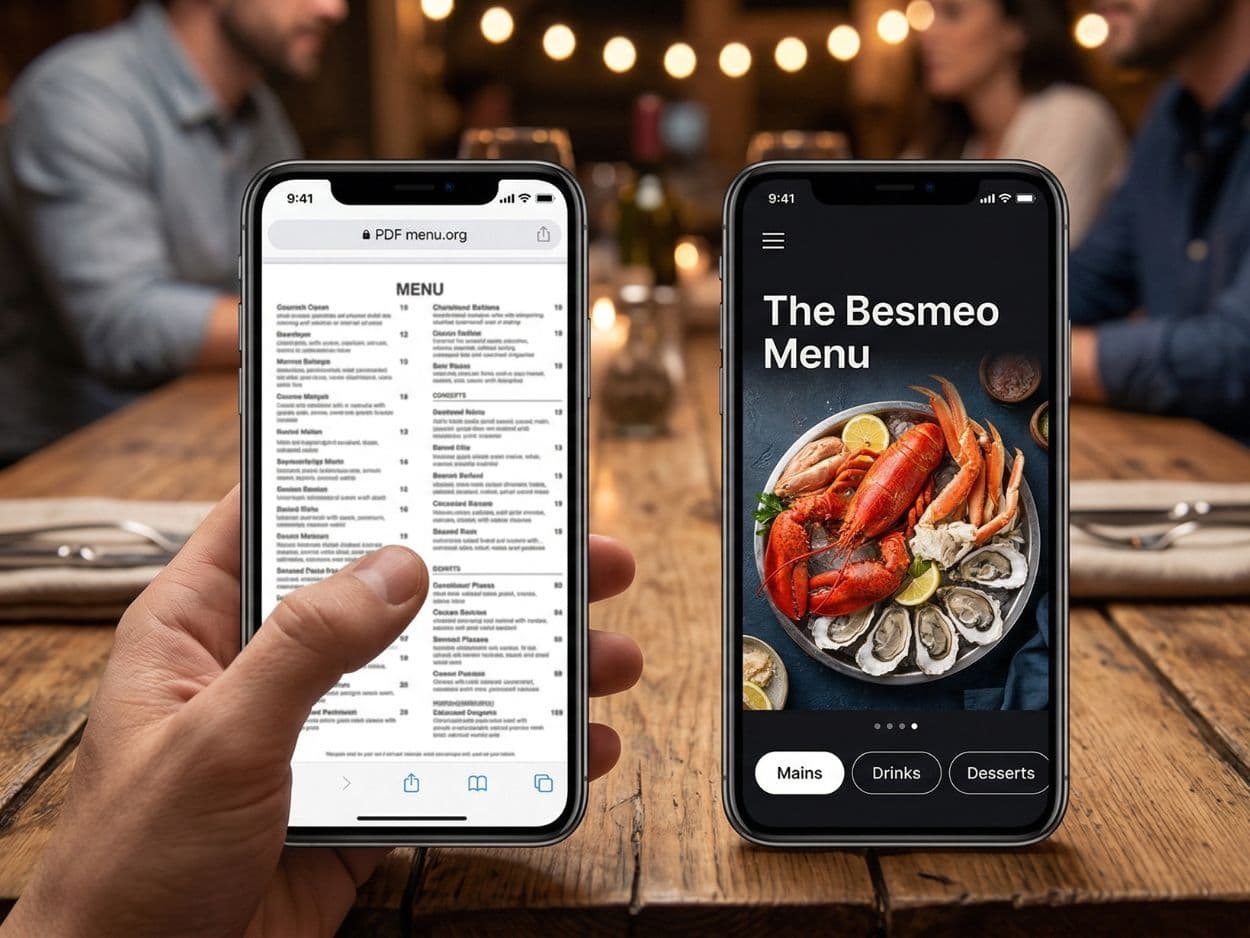
Their phone downloads a file. That file opens in a viewer that wasn't designed for reading menus. The text is tiny. They pinch and drag to find the section they want. They lose their place. They zoom in on one area and can't see the prices next to it. If they're outside, the glare makes it unreadable. If they're on a slow connection, it takes 10 seconds to load.
By the time they've figured out where the entrées are, their server has already come and gone once.
The result: they order fast, they order safe, they order cheap. The $34 seafood platter you actually make money on? They never even saw it.
This isn't speculation. Restaurants that switch from PDF menus to proper digital menus consistently report higher average checks. The reason is simple: when people can actually read your menu and see photos of the food, they order more and they order better.
"But my PDF works fine"
Does it, though?
Pull out your phone right now. Scan your own QR code. Try to read your menu the way a customer would — standing, in variable lighting, probably a little impatient.
Now ask yourself:
Can someone find your appetizers in under 3 seconds? Can they see a photo of any dish? Can they read the descriptions without zooming? If they don't speak English, can they understand anything at all? Does it look like a restaurant they want to spend $50 at?
If you answered no to more than one of those, your menu is working against you.
What tourists actually do when they can't read your menu
If your restaurant is anywhere near a tourist area — and in the US, that's a lot of places — this part matters.
A tourist walks in. They scan the QR code. They get a PDF in English. But English isn't their first language. Maybe they're from Brazil, Germany, Japan, France. They can sort of understand the menu, but not really. They don't know what "blackened mahi-mahi" means. They don't know what a "flight" of anything is. "Surf and turf" means nothing to them.
So they do what every tourist does: they point at something they recognize. Chicken. Burger. Caesar salad. Beer.
Meanwhile, your kitchen just prepped fresh catch that goes for $38 a plate, and nobody at that table will ever know it exists. Not because they wouldn't want it, but because they literally couldn't understand what it was.
Multiply that by every tourist table, every service, every week. That's a lot of money walking out the door.
What a proper digital menu actually looks like
A real digital menu isn't a file. It's a web page optimized for phones. When a customer scans your QR code, it opens instantly in their browser — no download, no app, no waiting.
Here's the difference:
A PDF menu is a static image of a piece of paper. A digital menu is a mobile experience designed to sell food.
A good digital menu has clear categories that customers can tap to jump between sections. It has photos that make people hungry. It has descriptions that tell you what you're getting without making you guess. And if it's built right, it detects the customer's phone language and shows the menu in their native language automatically.
The customer doesn't need to zoom. They don't need to scroll through a 4-page document. They tap "Seafood," they see the catch of the day with a photo, they order it. Done.
The real cost of not switching
Let's do some basic math.
Say your average check goes up $4 per table when customers can actually see and understand your full menu. That's a conservative number — some restaurants report $6-8 increases.
If you turn 30 tables a day, that's $120 more per day. That's $3,600 per month. From doing nothing except making your menu readable.
Now compare that to the cost of a digital menu tool, which ranges from $10 to $50 a month. The ROI isn't even close.
And that's before counting the time your servers save not explaining every dish to confused tourists, or the reprint costs you eliminate every time you change a price or add a seasonal item.
What to look for in a digital menu tool
Not all digital menu platforms are the same. Some are just slightly prettier PDFs. Here's what actually matters:
Mobile-first design. If the menu wasn't built for phones first, it's going to feel clunky on phones. Most of your customers are scanning a QR code from a smartphone. The menu needs to be instant, clean, and easy to navigate with one thumb.
Photos for every dish. Menus with food photos see up to 30% higher order values on popular items. If you don't have professional photos of your dishes, some platforms can generate them for you using AI — and yes, they look surprisingly good.
Multilingual support. If you're in any kind of tourist market, your menu should be readable in at least 3-4 languages. Automatic translation that detects the customer's phone language is the gold standard. Manual translations that require you to type everything again in Spanish, French, and Portuguese are not realistic for a busy restaurant owner.
Instant updates. You should be able to change a price, 86 an item, or add a daily special from your phone in under 30 seconds. If you need to call someone, email a file, or wait for a designer, it's the wrong tool.
One QR code forever. Your QR code should never change, no matter how many times you update the menu. Print once, update forever.
The bottom line
Your food is good. Your service is solid. But if your menu is a PDF that nobody can read, you're leaving money on every single table, every single day.
The restaurants that figure this out first don't just get a nicer-looking menu. They get higher checks, happier tourists, fewer questions to their servers, and a professional image that matches the quality of their food.
The ones that don't will keep wondering why the average check isn't going up, even though the food has never been better.
Your menu should sell your food for you. If it's not doing that, it's time to replace it.
See it for yourself
Upload your current menu and watch it transform in under 60 seconds. No signup, no credit card, no commitment.